There is a particular kind of internet conversation that always makes me laugh.
Someone tells you that you are wrong.
Not “I think you might be wrong.”
Not “That isn’t how I remember it.”
Not even “Have you got a source for that?”
Just:
You are wrong.
Then, if you push back, the confidence somehow increases.
Where is your evidence?
They never said that.
You cannot prove they said that.
And then you post the screenshot.
Silence.
Beautiful, immediate silence.
The Dead by Daylight Incident
One of my favourite examples came from a discussion about Dead by Daylight.
There had been some controversy around a joke made during a developer discussion and, more specifically, the context surrounding it.
The useful thing about this particular example is that the original moment is still there to watch for yourself.
Behaviour Interactive also later addressed what had happened and explained that the comment had been intended as a joke.
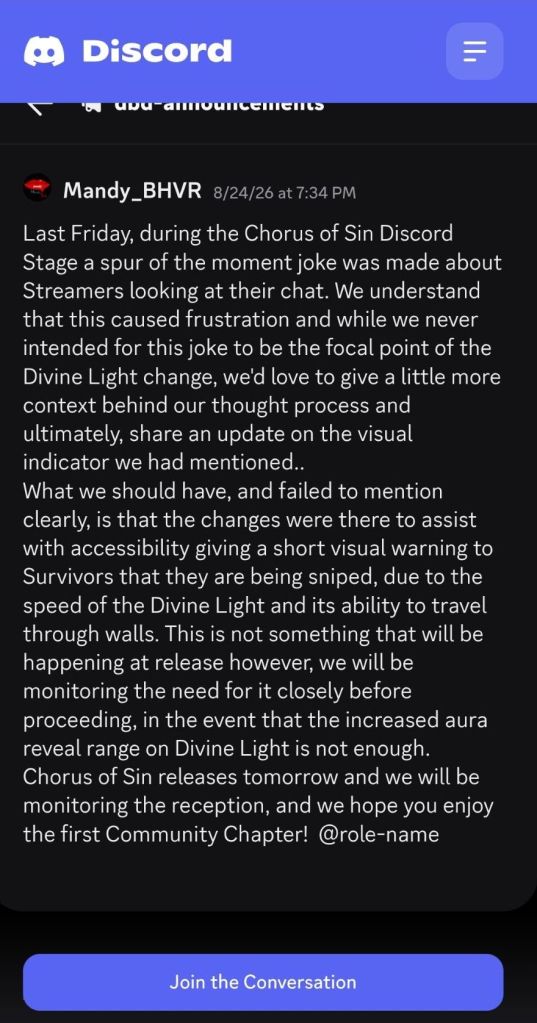
I still have the screenshot of that statement too.
That became rather useful when I mentioned the developer explanation in a comment and somebody confidently told me I was wrong.
Not that they interpreted the statement differently.
Not that they disagreed with what the developers meant.
According to them, the developers simply had not said what I claimed they had said.
Then came the challenge.
Where was my evidence?
Apparently, I could not provide any proof that the developers had actually said it.
Which was unfortunate.
Because I had the screenshot.
So I attached it.
There were the developers, explaining the exact thing I had just been told they had never explained.
And then…
Nothing.
The conversation stopped.
I would love to claim I handled this moment with enormous maturity and felt absolutely no satisfaction whatsoever.
That would be a lie.
It was very funny.
But the interesting part was not that I had managed to “win” an internet argument.
It was how quickly absolute certainty disappeared once evidence entered the conversation.
Before the screenshot, there was apparently no room for doubt.
After the screenshot, there was apparently no room for a reply.
Asking for Evidence Is Good
There is an important distinction here.
Someone asking me to prove something does not bother me.
They should.
If I make a factual claim, especially one about something a developer, company or creator supposedly said, asking for a source is perfectly reasonable.
We should probably do that more often.
The problem starts when:
“Do you have evidence?”
quietly becomes:
“There is no evidence because I already know you are wrong.”
Those are not the same position.
The first leaves room for new information.
The second has already decided what the answer is going to be.
That is where confidence starts pretending to be evidence.
The Burden of Proof Works Both Ways
I have had another argument where somebody asked me to provide evidence for what I was saying.
Fair enough.
So I did.
I supplied the evidence supporting my position.
Then I asked them to do the same.
That was apparently where our shared enthusiasm for evidence ended.
They pretty much refused.
The conversation then went in a direction that I will politely leave out of this Reflection.
It certainly did not involve them producing a source.
That exchange stuck with me because it highlighted something important about the burden of proof.
If I make a factual claim, the burden is on me to support it.
But if you make a factual claim in response, the same applies to you.
It is not a special rule that only exists for the person you disagree with.
You cannot reasonably say:
“Prove it.”
Receive the evidence.
Make your own counterclaim.
And then decide that you somehow do not need to support yours.
If both people are making factual claims, both people have something to back up.
Evidence Is Not Absolute Certainty
There is another distinction worth making.
Providing evidence does not necessarily mean you have proved something beyond any possible doubt.
Evidence can be strong.
It can be weak.
It can be incomplete.
Two people can look at the same evidence and reasonably disagree about what conclusion it supports.
That is where an actual discussion can happen.
You compare sources.
You look at context.
You question assumptions.
You decide how much confidence the available evidence actually justifies.
But there is a big difference between:
“I don’t think your evidence proves that.”
and:
“You have no evidence.”
Especially when the evidence is currently sitting underneath your comment.
Confidence Sounds Convincing
The internet rewards certainty.
“This might be the case” does not travel particularly far.
“This is DEFINITELY what happened” does.
Someone can write a completely unsupported claim with enough confidence and suddenly everybody else has to disprove it.
You see it constantly with games.
A developer supposedly abandoned something.
A mechanic supposedly works a particular way.
A studio definitely promised something.
A game is definitely dead.
Something was definitely never said.
Sometimes those claims are correct.
Sometimes they have simply been repeated so often that nobody remembers where they originally came from.
And sometimes somebody posts a screenshot that makes the whole conversation very awkward.
I Am Not Immune to This Either
It would be very easy for me to write this as if I am the heroic keeper of screenshots who has never been confidently wrong about anything.
That would itself be a very confident claim with very little supporting evidence.
I have remembered things incorrectly.
I have misunderstood things.
I have been certain about something, checked it, and discovered that my brain had helpfully rewritten history.
That is normal.
Being wrong is not really the problem.
What matters is what you do when somebody produces better evidence.
If someone shows me that I got something wrong, then I got it wrong.
Fair enough.
Change the position and move on.
There is no leaderboard.
You do not lose Internet Points.
The Screenshot Does Not Care
That is probably why these exchanges amuse me so much.
You can argue with someone’s opinion.
You can disagree with their interpretation.
You can debate what a developer meant.
But if the argument is:
“They never said that.”
and someone produces a screenshot of them saying it…
There is not a huge amount of room left to manoeuvre.
The screenshot does not care how confident anybody was five minutes earlier.
It just sits there.
Menacingly.
Receipts Still Need Context
Of course, screenshots are not magical truth machines either.
Things can be cropped.
Statements can be taken out of context.
Developers can change their minds.
Something said years ago might no longer reflect the current game.
That is why, with the Dead by Daylight example, I would rather provide both pieces.
The original moment.
And the later explanation from the developers themselves.
Readers do not have to take my word for it.
They can look at the evidence themselves.
That is how it should be.
Certainty Is Cheap
I think this is the bit that interests me most.
Being confident costs nothing.
Checking does.
You have to search for the original post.
Find the interview.
Read the patch notes.
Look through old announcements.
Make sure you remembered it correctly.
It takes more effort than simply typing:
“No they didn’t.”
That probably explains why the second one happens so often.
But confidence is not evidence.
Volume is not evidence.
Ten people repeating the same thing is not evidence.
And somebody sounding absolutely certain does not magically make their memory more reliable than everyone else’s.
Sometimes the boring person with the screenshot wins.
Leave Yourself Somewhere to Go
There is a really easy way to avoid most of this.
Leave yourself a little room to be wrong.
“I don’t remember them saying that.”
“I thought it worked differently.”
“Have you got the source?”
Those sentences do exactly the same job without planting a flag on a hill you might have to evacuate five minutes later.
Because one day somebody might actually have the screenshot.
And when they post it, suddenly your very confident argument has become somebody else’s favourite internet story.
Trust me.
I have one.
Confidence is useful.
Evidence is better.


Leave a Reply