Survivor Reflections: Same Game, Different Skills

There is something very satisfying about watching confidence collide with specialisation.

Fortnite recently provided a particularly good example.

A group of players known primarily for competitive Build Fortnite went up against players who specialise in Zero Build.

Beforehand, there had been plenty of confidence from the Build side.

Clix, one of the most recognisable competitive Build players involved in the wider discussion, had been openly dismissive of how the Zero Build specialists would fare.

A widely shared clip from the argument also attributes to him the much stronger prediction that the Zero Build players would not even qualify for the finals.

I have not been able to find a clean original VOD containing that exact line, so I am not going to pretend I have.

What is considerably easier to establish is the general argument:

Build pros were expected to be able to step into Zero Build and beat the specialists there too.

Then people actually started playing.

And that assumption did not survive particularly well.

The Zero Build specialists won the series of direct challenges, with discussion around the matchups recording a 4–0 result across the recent contests.

Naturally, the internet immediately started doing what the internet does.

Build players are washed.

Zero Build players are better.

Building apparently means you cannot aim.

Pick a side.

And I think that misses the most interesting part of what happened.

Because the result does not prove Zero Build players are universally better at Fortnite.

It proves something much simpler.

Being exceptional at one version of a game does not automatically make you exceptional at another.

Same Fortnite, Different Fortnite

On the surface, Build and Zero Build are obviously still Fortnite.

Same characters.

Same weapons.

Same movement.

Same map.

Same basic Battle Royale objective.

Drop in.

Get equipped.

Stay alive.

Be the last player or team standing.

Epic even runs separate competitive events for Battle Royale and Zero Build.

They share enormous amounts of DNA.

But remove building and something fundamental changes.

In Build mode, players can create their own cover.

They can control pieces.

Edit structures.

Protect themselves almost instantly.

Turn an open area into a defensible position.

Create angles that did not exist seconds earlier.

A highly skilled Build player is doing far more than simply aiming and shooting.

The building itself is a massive skill.

Anyone pretending otherwise has probably never watched high-level Fortnite and tried to understand what is actually happening on screen.

Some of the mechanical speed involved is ridiculous.

But Zero Build removes that entire layer.

And removing one skill does not necessarily make everything else irrelevant.

Sometimes it makes the remaining skills matter more.

You Can’t Just Put Up a Wall

This is probably the biggest difference.

In Builds, getting caught in a bad position does not automatically mean the fight is over.

A good player can react.

Wall.

Ramp.

Box.

Edit.

Reset.

Suddenly the opponent who had the advantage has to deal with a structure that did not exist moments earlier.

Zero Build does not give you that option.

If you run across an exposed area and somebody starts shooting at you, the game does not care that you can perform twelve edits before I have finished working out which button places a wall.

There is no wall.

You picked the wrong route.

Now you have a problem.

Natural cover matters more.

Movement matters differently.

Terrain matters.

Rotations matter.

Knowing when to cross open ground matters.

Knowing where the next safe position is matters.

And because you cannot manufacture protection whenever you need it, mistakes in positioning can become much harder to recover from.

That is a skill set.

Just a different one.

I Learned That on a Much Smaller Scale

I have played Fortnite myself in the past.

I was bad at Builds.

There really is not a more generous way of describing it.

Someone would start constructing a small housing estate around me and I would still be trying to remember what I wanted to build in the first place.

Zero Build was different.

I did alright.

Not professionally.

Not spectacularly.

I am not about to announce my late entry into competitive Fortnite.

But I was considerably more comfortable.

The things Zero Build asked me to think about suited me better.

Movement.

Where I was standing.

Where my cover was.

Whether crossing an area was actually a sensible idea.

My experience is obviously several galaxies away from what professional players are doing.

But the underlying point is the same.

Removing building did not simply make Fortnite easier for me.

It changed which skills the game was asking me to use.

Building Is a Skill Too

And I think this needs saying because otherwise the argument simply swings too far in the opposite direction.

Zero Build specialists beating Build pros does not prove building is some sort of crutch.

Building is an enormous part of competitive Fortnite.

Piece control.

Editing.

Defensive building.

Box fighting.

Resource management.

Creating advantageous angles.

Knowing how to take control of a fight vertically as well as horizontally.

Those skills take an absurd amount of practice.

Put Zero Build specialists into high-level Build fights against the same calibre of Build professionals and I would expect a completely different result.

And that is the point.

They are specialists too.

The Zero Build players involved in the recent argument were not pretending that they would walk into Builds and suddenly dominate.

They seemed perfectly aware of whose territory that would be.

Specialists are specialised.

That really should not be controversial.

The Recent Challenge Doesn’t Prove Everything Either

There is another important bit of context.

These recent matchups were not simply a full competitive Zero Build Battle Royale tournament where the Build pros entered and got destroyed.

They included smaller Creative team fights and wagers.

That tests plenty of relevant Zero Build skills.

Aim.

Movement.

Positioning.

Team fighting.

Using cover.

But it is not identical to surviving an entire high-level Battle Royale lobby.

Drop strategy matters there.

Rotations across an entire map matter.

Storm management matters.

Knowing when not to fight matters.

So I would be equally cautious about using these results to declare that Zero Build specialists will now automatically destroy Build professionals in every future Zero Build tournament.

That has not been proven either.

What the challenges did demonstrate was narrower.

The assumption that elite Build players could simply enter the Zero Build specialists’ environment and comfortably beat them did not hold up particularly well once they actually tried it.

That is interesting enough without turning it into something bigger.

Build Pros Have Already Proven They Can Adapt

There is another reason this should not become a victory lap against Build players.

Established Fortnite professionals from the Build scene have already demonstrated that those skills can transfer successfully into Zero Build.

In 2023, Kami and Japko won the $2 million Gamers8 Zero Build tournament.

That same year, Malibuca and Th0masHD won DreamHack Summer, another major Zero Build event.

These were not players who suddenly lost all of their Fortnite ability because somebody disabled building.

They adapted.

Which tells us something important.

Skills transfer.

Aim transfers.

Game sense transfers.

Communication transfers.

Experience under pressure transfers.

Understanding Fortnite at an elite level obviously gives somebody an enormous head start.

But having transferable skills is not the same as instantly inheriting expertise in every version of the game.

You still have to learn how that version works.

PUBG and Warzone Are Both Battle Royales

This becomes even easier to understand once you move outside Fortnite.

Take PUBG and Call of Duty: Warzone.

Both are Battle Royales.

You enter a large map.

You acquire weapons and equipment.

The playable area gets smaller.

Players are eliminated.

Last player or team standing wins.

Clearly there are transferable skills.

Someone who is genuinely elite at PUBG is probably not going to load into Warzone and suddenly forget how to aim.

They understand positioning.

Communication.

Target acquisition.

Rotations.

When to engage.

When to disengage.

How Battle Royale matches flow.

But would I expect an elite PUBG player to install Warzone for the first time and immediately start beating the best Warzone professionals?

Of course not.

Because Warzone is not PUBG.

The Details Change Everything

PUBG itself describes its Blue Zone as something that shapes when players move, where they position themselves and what risks they choose to take.

Terrain and rotation decisions can dictate what options are available several minutes later.

A bad movement across the map can destroy a match before the shooting even starts.

Warzone shares the basic Battle Royale DNA but has historically layered very different systems over it.

Gulags.

Buy Stations.

Cash.

Loadouts.

Redeployment systems.

Activision’s own 2026 Black Ops Royale announcement actually demonstrates the point nicely: it specifically describes how removing the Gulag, Buy Stations, cash and loadouts makes that mode different from traditional Warzone Battle Royale.

Change a few systems and suddenly players have to make different decisions.

Being great at Battle Royale helps with both.

Being great at one Battle Royale does not automatically make you elite at another.

Nobody finds that particularly surprising.

Yet because Build and Zero Build happen inside the same game, people sometimes act as though their skills should transfer perfectly.

They don’t.

Rocket League Might Be an Even Cleaner Example

Rocket League makes the same point without even requiring us to change games.

The car is the same.

The ball is the same.

The boost is the same.

The physics are the same.

The controls are the same.

Yet Rocket League has formal high-level competition across 1v1, 2v2 and 3v3 formats.

And those formats do not ask exactly the same thing from a player.

In 1v1, there is nobody rotating behind you.

There is nobody covering the goal because you decided that challenge definitely looked like a good idea at the time.

An overcommit can immediately turn into a goal.

Kick-offs carry enormous importance.

Boost management changes.

Defensive positioning changes.

The risk attached to every challenge changes.

Move into 3v3 and suddenly rotations, passing, spacing and teammate coverage become much larger parts of the decision-making process.

The mechanical ability transfers.

The understanding of Rocket League transfers.

But the decisions change.

Same game.

Same mechanics.

Different specialisation.

Counter-Strike and Valorant Share DNA Too

Then there are games that are clearly relatives without being the same game.

Counter-Strike 2 and Valorant are obvious examples.

Both are highly competitive tactical shooters.

Both reward precise aim.

Crosshair placement.

Map knowledge.

Communication.

Economy management.

Knowing when to take a fight.

Understanding angles.

Playing around teammates.

An elite Counter-Strike player moving into Valorant is hardly starting from zero.

They arrive with years of relevant experience.

But Valorant then adds something fundamental.

Agents.

Abilities.

Different ways of controlling areas.

Different combinations of utility.

Riot itself describes Valorant as a 5v5 tactical shooter combining sharp gunplay with Agents carrying unique tactical abilities.

Those systems create decisions that simply do not exist in exactly the same way in Counter-Strike.

And the reverse applies too.

An elite Valorant professional does not load into Counter-Strike and magically know every grenade lineup, timing, smoke interaction and piece of accumulated map knowledge because they are good at another tactical shooter.

The shared DNA gives them a substantial head start.

It does not hand them mastery.

Harder Does Not Mean Every Skill Is Harder

I think part of the Fortnite argument comes from the belief that Builds has a higher mechanical skill ceiling.

There is a perfectly reasonable argument for that.

Building adds an enormous mechanical system that Zero Build does not have.

If two modes share shooting, movement and weapons while one adds building on top, it is easy to look at that and conclude:

Builds is harder.

Maybe as a complete mechanical package, it is.

But that does not mean every individual skill required to succeed is automatically harder in Builds.

Zero Build removes the ability to create cover.

That changes positioning.

It changes how exposed movement is punished.

It changes the importance of terrain.

It changes which fights are sensible.

It changes how mistakes can be recovered from.

You can remove one mechanic and increase the importance of another.

A simpler ruleset does not automatically mean mastery is simple.

Being Good at the Game Isn’t One Thing

I think this is what I like most about the whole situation.

People talk about being “good at Fortnite” as though that describes one ability.

It doesn’t.

Someone can have incredible aim and mediocre positioning.

Someone can understand rotations brilliantly but struggle in close-range fights.

Someone can be mechanically absurd in Builds and still make poor decisions when building is taken away.

Someone else can understand Zero Build terrain perfectly and have absolutely no idea what to do when another player boxes them in and starts editing walls at a speed normally associated with industrial machinery.

Games contain overlapping skills.

Not identical ones.

The same applies to PUBG and Warzone.

Rocket League 1v1 and 3v3.

Counter-Strike and Valorant.

And plenty of other games that look similar enough that we assume expertise should transfer automatically.

It rarely does.

Respect the Specialist

That is really where I land on the recent Fortnite result.

There is nothing embarrassing about an elite Build player not immediately being the best Zero Build player.

Why should they be?

They have spent thousands of hours refining a particular competitive skill set.

Likewise, there is nothing surprising about somebody who has dedicated huge amounts of time to Zero Build understanding its fights better than somebody who normally plays another mode.

That is what specialisation is.

The mistake was assuming expertise in one automatically granted expertise in the other.

And the Zero Build players seemed to understand the reverse.

Put them into Builds against elite Build professionals and they were not pretending everything would be fine.

They knew whose territory they would be entering.

That is not weakness.

That is recognising expertise.

Same Game, Different Skills

The funniest part of this whole argument is that both sides can be exceptional Fortnite players at the same time.

There does not actually need to be a loser in the larger argument.

Build professionals can be mechanically incredible.

Zero Build professionals can be incredible at Zero Build.

Build players can learn Zero Build and become excellent at it.

We already know some have.

Zero Build players can learn Builds too.

Nothing about one group’s success needs to invalidate the other.

What happened recently was simply a useful demonstration of something games regularly teach us.

Being great at something related is an advantage.

It is not a substitute for experience.

Skills transfer.

Talent transfers.

Game sense transfers.

Expertise still has to be earned.

Because sometimes it can be the same map.

The same weapons.

The same characters.

Even the same game.

And still require a completely different way of surviving.
Survivor Reflection: Confidence Is Not Evidence

There is a particular kind of internet conversation that always makes me laugh.

Someone tells you that you are wrong.

Not “I think you might be wrong.”

Not “That isn’t how I remember it.”

Not even “Have you got a source for that?”

Just:

You are wrong.

Then, if you push back, the confidence somehow increases.

Where is your evidence?

They never said that.

You cannot prove they said that.

And then you post the screenshot.

Silence.

Beautiful, immediate silence.

The Dead by Daylight Incident

One of my favourite examples came from a discussion about Dead by Daylight.

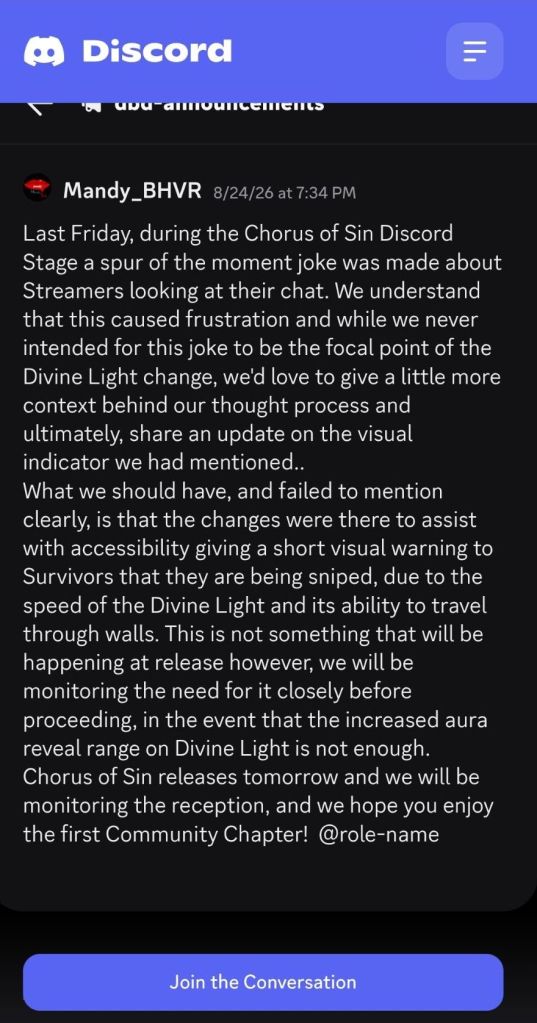
There had been some controversy around a joke made during a developer discussion and, more specifically, the context surrounding it.

The useful thing about this particular example is that the original moment is still there to watch for yourself.

Behaviour Interactive also later addressed what had happened and explained that the comment had been intended as a joke.

I still have the screenshot of that statement too.

That became rather useful when I mentioned the developer explanation in a comment and somebody confidently told me I was wrong.

Not that they interpreted the statement differently.

Not that they disagreed with what the developers meant.

According to them, the developers simply had not said what I claimed they had said.

Then came the challenge.

Where was my evidence?

Apparently, I could not provide any proof that the developers had actually said it.

Which was unfortunate.

Because I had the screenshot.

So I attached it.

There were the developers, explaining the exact thing I had just been told they had never explained.

And then…

Nothing.

The conversation stopped.

I would love to claim I handled this moment with enormous maturity and felt absolutely no satisfaction whatsoever.

That would be a lie.

It was very funny.

But the interesting part was not that I had managed to “win” an internet argument.

It was how quickly absolute certainty disappeared once evidence entered the conversation.

Before the screenshot, there was apparently no room for doubt.

After the screenshot, there was apparently no room for a reply.

Asking for Evidence Is Good

There is an important distinction here.

Someone asking me to prove something does not bother me.

They should.

If I make a factual claim, especially one about something a developer, company or creator supposedly said, asking for a source is perfectly reasonable.

We should probably do that more often.

The problem starts when:

“Do you have evidence?”

quietly becomes:

“There is no evidence because I already know you are wrong.”

Those are not the same position.

The first leaves room for new information.

The second has already decided what the answer is going to be.

That is where confidence starts pretending to be evidence.

The Burden of Proof Works Both Ways

I have had another argument where somebody asked me to provide evidence for what I was saying.

Fair enough.

So I did.

I supplied the evidence supporting my position.

Then I asked them to do the same.

That was apparently where our shared enthusiasm for evidence ended.

They pretty much refused.

The conversation then went in a direction that I will politely leave out of this Reflection.

It certainly did not involve them producing a source.

That exchange stuck with me because it highlighted something important about the burden of proof.

If I make a factual claim, the burden is on me to support it.

But if you make a factual claim in response, the same applies to you.

It is not a special rule that only exists for the person you disagree with.

You cannot reasonably say:

“Prove it.”

Receive the evidence.

Make your own counterclaim.

And then decide that you somehow do not need to support yours.

If both people are making factual claims, both people have something to back up.

Evidence Is Not Absolute Certainty

There is another distinction worth making.

Providing evidence does not necessarily mean you have proved something beyond any possible doubt.

Evidence can be strong.

It can be weak.

It can be incomplete.

Two people can look at the same evidence and reasonably disagree about what conclusion it supports.

That is where an actual discussion can happen.

You compare sources.

You look at context.

You question assumptions.

You decide how much confidence the available evidence actually justifies.

But there is a big difference between:

“I don’t think your evidence proves that.”

and:

“You have no evidence.”

Especially when the evidence is currently sitting underneath your comment.

Confidence Sounds Convincing

The internet rewards certainty.

“This might be the case” does not travel particularly far.

“This is DEFINITELY what happened” does.

Someone can write a completely unsupported claim with enough confidence and suddenly everybody else has to disprove it.

You see it constantly with games.

A developer supposedly abandoned something.

A mechanic supposedly works a particular way.

A studio definitely promised something.

A game is definitely dead.

Something was definitely never said.

Sometimes those claims are correct.

Sometimes they have simply been repeated so often that nobody remembers where they originally came from.

And sometimes somebody posts a screenshot that makes the whole conversation very awkward.

I Am Not Immune to This Either

It would be very easy for me to write this as if I am the heroic keeper of screenshots who has never been confidently wrong about anything.

That would itself be a very confident claim with very little supporting evidence.

I have remembered things incorrectly.

I have misunderstood things.

I have been certain about something, checked it, and discovered that my brain had helpfully rewritten history.

That is normal.

Being wrong is not really the problem.

What matters is what you do when somebody produces better evidence.

If someone shows me that I got something wrong, then I got it wrong.

Fair enough.

Change the position and move on.

There is no leaderboard.

You do not lose Internet Points.

The Screenshot Does Not Care

That is probably why these exchanges amuse me so much.

You can argue with someone’s opinion.

You can disagree with their interpretation.

You can debate what a developer meant.

But if the argument is:

“They never said that.”

and someone produces a screenshot of them saying it…

There is not a huge amount of room left to manoeuvre.

The screenshot does not care how confident anybody was five minutes earlier.

It just sits there.

Menacingly.

Receipts Still Need Context

Of course, screenshots are not magical truth machines either.

Things can be cropped.

Statements can be taken out of context.

Developers can change their minds.

Something said years ago might no longer reflect the current game.

That is why, with the Dead by Daylight example, I would rather provide both pieces.

The original moment.

And the later explanation from the developers themselves.

Readers do not have to take my word for it.

They can look at the evidence themselves.

That is how it should be.

Certainty Is Cheap

I think this is the bit that interests me most.

Being confident costs nothing.

Checking does.

You have to search for the original post.

Find the interview.

Read the patch notes.

Look through old announcements.

Make sure you remembered it correctly.

It takes more effort than simply typing:

“No they didn’t.”

That probably explains why the second one happens so often.

But confidence is not evidence.

Volume is not evidence.

Ten people repeating the same thing is not evidence.

And somebody sounding absolutely certain does not magically make their memory more reliable than everyone else’s.

Sometimes the boring person with the screenshot wins.

Leave Yourself Somewhere to Go

There is a really easy way to avoid most of this.

Leave yourself a little room to be wrong.

“I don’t remember them saying that.”

“I thought it worked differently.”

“Have you got the source?”

Those sentences do exactly the same job without planting a flag on a hill you might have to evacuate five minutes later.

Because one day somebody might actually have the screenshot.

And when they post it, suddenly your very confident argument has become somebody else’s favourite internet story.

Trust me.

I have one.

Confidence is useful.

Evidence is better.

Survivor Reflection: Apparently Every Game Is Dying

Apparently Every Game Is Dying

At least, that is how it sometimes sounds if you spend enough time around gaming videos, streams, and comment sections. A player count drops, a streamer moves on, an update lands badly, and suddenly the post-mortem begins. The game is dead. The developers have failed. It needs a new mode, a new season, a battle pass, a Battle Royale, or whatever else is currently being treated as the answer to everything.

One example that caught my attention recently was ARC Raiders. A streamer was arguing that the game was dying because the developers had not done enough to protect streamers.

That stopped me for a second.

Not because stream sniping, harassment, or anything else that directly targets creators should be ignored. Those are genuine problems. But there is a fairly substantial gap between saying a game needs better tools to deal with those problems and declaring that the game itself is dying because streamers are not being protected enough.

Especially when you look at the numbers.

At the time of writing this, ARC Raiders was sitting at roughly 20,000 to 25,000 concurrent players on Steam alone. That does not include anyone playing on PlayStation or Xbox. Its Steam peak reached around 482,000 concurrent players, while its reported peak across all platforms eventually reached around 960,000.

That is a huge drop. I am not going to pretend otherwise.

But a huge drop from an enormous peak does not automatically make a game dead.

Launches are spikes. People buy games because everyone is talking about them. Friends convince friends to join. Streamers pile in. Videos appear everywhere. Some people stay for hundreds of hours, some play for a few weeks, and some decide fairly quickly that it is not for them.

Eventually, that initial wave settles.

What you are left with is the audience that actually wants to keep playing.

That number seems far more useful to me than constantly comparing everything back to the highest number a game ever managed.

There are plenty of examples of games that have found long-term audiences without needing to live permanently at their peak. Hunt: Showdown has spent years building its community. Team Fortress 2 was released in 2007 and is still going. Left 4 Dead 2 arrived in 2009 and still attracts thousands of players. Warframe has been running since 2013. No Man’s Sky has been around for a decade.

None of them need to be the biggest game in the world to justify continuing to exist.

Which is where I start having trouble with the phrase “dead game.”

If tens of thousands of people are still playing something, how exactly are we defining dead?

And are we actually talking about the health of the game anymore, or how useful that game is to the people making content from it?

Dead for the Game, or Dead for the Streamer?

This is where I think the conversation starts getting muddled.

A streamer can stop getting the same results from a game long before that game actually has a problem.

Maybe fewer people are watching it. Maybe the category has slipped down Twitch. Maybe their regular viewers have moved on to something newer. Maybe clips are not travelling as far as they used to. Maybe another game is simply performing better for them.

None of that means they are lying when they say the game feels quieter.

It just means they are looking at it from a very different position.

For somebody whose income depends on people watching them play games, player numbers are only part of the equation. They also have to think about audience size, discoverability, trends, sponsorships and whether spending six hours streaming one game is actually worth doing compared with something else.

Most players do not have that problem.

If I load up a game and find a match without much trouble, I do not particularly care where it currently sits on Twitch. I do not need my session to generate views. I do not need a clip from it to perform well. I certainly do not need an algorithm to approve of what I decided to play that evening.

I just need the game to work.

That is why comments about protecting streamers can sound strange when they are tied directly to the health of the game itself.

Stream sniping is a legitimate problem. Harassment is a legitimate problem. Developers should have systems in place to deal with behaviour that deliberately targets individual players, whether they stream or not.

But streamers are still only one part of the overall player base.

If somebody decides they no longer want to stream a game because those problems make broadcasting it frustrating, I can understand that. If enough creators leave, that may even hurt the game’s visibility.

What I struggle with is the jump from that to saying the game itself is dying.

Those are two different conversations.

A game becoming worse content does not automatically make it a worse game.

When somebody has built part of their audience around one particular game, any decline probably feels much larger from their side. If fewer people are watching, fewer people are talking about it, and the next big release is pulling viewers elsewhere, then from inside that bubble it probably does look as though everything is disappearing.

Outside that bubble, thousands of people may still be quietly playing.

They just are not broadcasting it.

Why Does Everything Need the Latest Popular Mode?

Once a game has been declared to be struggling, the next stage seems remarkably predictable.

Add whatever happens to be popular.

For a while, that meant Battle Royale.

If a multiplayer game was not pulling in enough people, somebody would suggest a Battle Royale mode. It did not seem to matter whether the game was built for it, whether it suited the pacing, or whether the existing players even wanted it.

Battle Royale was popular, therefore everything apparently needed Battle Royale.

Now the same thing happens with extraction modes, seasonal structures, battle passes, ranked systems and whatever else is currently doing well elsewhere.

Sometimes that can work.

A new mode can give a game a second life. A seasonal structure can help keep things moving. An update can bring people back.

But there is a difference between adding something because it improves the game and adding something because another game is making money from it.

That distinction matters.

If every struggling multiplayer game responds by copying the same few ideas, eventually they all start chasing the same audience with increasingly similar systems.

At that point, what exactly is supposed to make one of them stand out?

Not every shooter needs Battle Royale. Not every multiplayer game needs extraction mechanics. Not every game needs a battle pass stretching across several months so players feel obliged to keep logging in.

Sometimes the thing that makes a game worth playing is that it does not do what everything else is doing.

There is also a strange assumption behind these suggestions that more modes automatically means more players.

It can just as easily mean splitting the players you already have.

If one game has several different playlists, ranked modes, casual modes, limited-time events, Battle Royale, extraction and whatever else has been added along the way, those players are now spread across all of them.

A game with a smaller population may actually be healthier with fewer good modes than with ten half-populated ones.

And sometimes the answer to a game losing players is not to reinvent it.

Maybe some people simply finished with it.

Maybe they got what they wanted from it and moved on.

That does not always need fixing.

The Expectation of Endless Content

That leads into another part of this discussion that I find increasingly strange: the idea that a game has somehow failed if people eventually run out of things to do.

Someone has played a game for 200 hours, unlocked almost everything, completed the main progression, explored the maps, tried the different modes and then says there is nothing left to do.

At some point, surely that just means you have finished with the game.

That is not the same thing as the game failing to provide enough.

There seems to be an expectation now, especially around multiplayer and live-service games, that they should constantly provide a reason to come back. New maps. New weapons. New characters. New events. New challenges. New passes. New rewards.

And if there is a quiet period, people start asking whether the developers have abandoned it.

I understand why that happens. If a game is sold as a live service, then ongoing support is part of the deal. Players are right to expect updates, fixes and some form of continued development.

But there has to be a limit somewhere.

A game cannot keep producing meaningful new content faster than people can consume it forever.

More importantly, I do not think it should have to.

There is nothing wrong with reaching the end of what a game currently offers, putting it down, and playing something else.

You can come back when there is an update.

Or you might never come back at all.

Either option is fine.

We seem to have become uncomfortable with the idea that games can simply end for us.

That does not necessarily mean reaching a credits screen. It can just mean reaching the point where you have had enough.

Maybe you played for 30 hours.

Maybe 300.

Maybe you got a month out of it and moved on.

If those hours were enjoyable, then the game did what it was supposed to do.

It becomes stranger when this expectation gets applied outside live-service games as well. Games are increasingly judged by how long they can hold someone’s attention rather than what they actually do with that time.

A 15-hour game can be dismissed for being too short.

A 100-hour game can be criticised for having nothing left to do once somebody has spent 100 hours doing everything.

Apparently the correct amount of content is now infinite.

I would rather have a game know what it wants to be, give me a reason to play it, and eventually let me leave.

Not every game needs to become a second job.

Sometimes being finished is allowed.

Old Games Are Not Dead Games

This is probably where my own way of playing games makes the whole “dead game” conversation feel even stranger.

A lot of what I play is old.

At the moment, I can quite happily move between something like Metroid Fusion, Diddy Kong Racing, Twilight Princess and whatever newer game happens to catch my attention.

None of those older games are receiving seasonal updates.

Nobody is waiting for the next Diddy Kong Racing roadmap.

Metroid Fusion does not need a battle pass.

Twilight Princess does not need a new multiplayer mode to bring people back.

They are simply games that still exist, and people still find reasons to play them.

Sometimes that reason is nostalgia. Sometimes somebody never played the game the first time around. Sometimes it is a challenge run, a randomizer, a ROM hack or just the desire to go back and see whether something still holds up.

That is one of the things I enjoy most about older games.

They are finished.

There is no pressure to keep up with a season. No fear that I have missed an event. No progression track sitting there reminding me that I have three weeks left to unlock something.

I can pick one up when I want to play it and put it down when I am finished.

And somehow, despite receiving no new content for years or even decades, many of these games are still being played.

Team Fortress 2 sits somewhere interesting between those worlds.

It is an old game, but it is also multiplayer. It has had years where people have complained about its condition, questioned Valve’s support for it and wondered how much longer it could keep going.

And yet people keep playing it.

Left 4 Dead 2 is much the same.

It does not need a yearly sequel, a seasonal roadmap or a constant stream of new content to justify people loading it up. They play because they still enjoy Left 4 Dead 2.

That almost feels like a strangely old-fashioned idea now.

Guild Wars is another example.

The original game launched in 2005, which makes it more than twenty years old now.

And it is still going.

People can still log in, still play through the campaigns, still return to characters they made years ago, and still find a community around it.

It is obviously not competing with modern MMOs or the latest live-service release for attention anymore.

It does not need to.

The fact that Guild Wars is still there more than two decades later is probably a better measure of its success than whether it happens to be pulling big numbers on Twitch in 2026.

That is longevity.

Not permanent relevance. Not endless growth. Just a game lasting because enough people still want it to exist.

None of this means every old multiplayer game can survive indefinitely. Servers cost money. Communities shrink. Matchmaking eventually becomes difficult. Some games genuinely do reach the point where there are not enough people left to sustain them.

That is what I would consider a game actually dying.

Not dropping from an enormous launch peak.

Not falling down the Twitch rankings.

Not having a quiet month between updates.

A game starts dying when the people who still want to play it can no longer reasonably do so.

Until then, I struggle with the idea that something is dead simply because it is no longer the centre of attention.

Attention moves on.

Games do not disappear with it.

A Game Does Not Need to Live Forever

None of this means games cannot actually die.

They can.

Servers close. Matchmaking populations fall far enough that finding a game becomes difficult. Developers stop supporting something because there are not enough players to justify the cost. Sometimes a launch goes badly, people leave, and they simply do not come back.

There are games where calling them dead is probably fair.

What I question is how quickly we seem to reach for that word.

A game launches with hundreds of thousands of players, settles into tens of thousands, and apparently we are already preparing the funeral.

Why?

Surely the more important question is whether the audience it has left is sustainable.

ARC Raiders does not need to return to its peak every weekend to prove it is alive. Team Fortress 2 does not need to compete with whatever released this month. Hunt: Showdown does not need to suddenly attract half a million people.

They need enough people who want to keep playing them.

That is going to look different for every game.

A huge production with expensive servers, constant development and hundreds of staff probably needs a much larger audience than something operated by a smaller team. There is no single player count where we can draw a line and declare everything above it alive and everything below it dead.

Context matters.

And perhaps that is the part that gets lost when player counts become content themselves.

A graph goes down, somebody takes a screenshot, and suddenly the decline becomes the story.

Sometimes it is worth talking about. A dramatic loss of players can expose problems with a game. If people are leaving because of poor updates, technical issues, cheating, monetisation or decisions that have damaged the experience, developers should pay attention.

But sometimes the line goes down because launch week ended.

Sometimes people finished what they wanted to do.

Sometimes another game came out.

Sometimes people just fancied playing something else.

That is normal.

I also think there is something strange about expecting every successful game to keep us indefinitely.

I do not want every game I enjoy to become a service that needs ten years of my attention.

Some games will become things I return to regularly. Others will give me a few good weeks. Some will last hundreds of hours. Others might be finished in an afternoon.

I do not think one is automatically more valuable than another.

If I eventually stop playing something, that does not mean the game died.

It might just mean my time with it ended.

And if thousands of other people decide to keep playing after I leave, then clearly the game carried on perfectly well without me.

If People Still Want to Play It, It Is Doing Its Job

I think this is probably where I land on all of it.

If people still want to play a game, and they still can, then that game is doing its job.

It does not need to dominate Twitch.

It does not need to sit at the top of Steam.

It does not need to keep breaking its own records.

It does not need to become whatever the current trend says it should become.

It just needs to give people a reason to come back.

That reason can be competition. It can be nostalgia. It can be a challenge run, a randomizer, a new character, a new update, a group of friends, or simply because somebody enjoys spending time in that world.

That is enough.

Gaming discussion gets pulled towards numbers very quickly. Concurrent players. Viewer counts. Peak users. Revenue. Retention.

Those numbers matter, especially to the people actually running these games.

But they do not tell me whether I am going to enjoy playing one.

They also do not tell me when I am supposed to stop enjoying it.

If I decide I want to play something that came out twenty years ago, I do not need to check whether it is currently relevant before I load it.

I do not need somebody on Twitch to tell me whether the game still matters.

I certainly do not need a graph to give me permission.

That is probably why I find the constant declarations of games dying more tiring than useful.

Sometimes a game really is in trouble.

Sometimes the signs are obvious.

But sometimes what we are actually watching is a game settling into the audience it was always going to have once the noise around launch disappeared.

And sometimes the person saying a game is dead is really just saying they are done with it.

Those are not the same thing.

Games do not need to live forever.

They do not need to keep every player forever.

They do not need to stay at the centre of the conversation forever.

They just need to be worth playing while you are there.

And if people are still loading them up years later, then maybe they were never as dead as everyone kept saying.

Maybe that is what has been bothering me most about all of this.

It is completely fine to stop enjoying a game.

It is completely fine to be frustrated by stream sniping, bad updates, balance changes, cheating, or anything else that makes playing it less enjoyable.

But none of those things automatically mean the game is dying.

Sometimes you are just done with it.

And that is allowed.

You do not need to turn losing interest into a diagnosis for the entire player base.

Sometimes the game is still doing perfectly well.

You just stopped having fun.

There is a difference.

Retro Reflections: Conker’s Bad Fur Day

How Did Rare Get Away With This?

Revisiting the Games That Shaped a Lifetime of Gaming

There was one thought that kept coming back to me throughout my return to Conker’s Bad Fur Day.

How did Rare get away with putting this on a Nintendo console?

Nintendo had built a reputation around games that could be enjoyed by almost anyone. Yet here was a Nintendo 64 game involving alcohol, swearing, violence, toilet humour and more than a few moments that made me wonder how some of it ever made it onto the cartridge.

And somehow, underneath all of that, there was still a very good game.

From Diddy Kong Racing to a Very Bad Day

Perhaps the strangest part is remembering where Conker started.

His first released appearance was in Diddy Kong Racing in 1997. There he was just another colourful Rare character racing around Timber’s Island alongside Diddy, Banjo, Krunch and the rest of the cast.

Nothing about that version of Conker suggested what was coming.

And Diddy Kong Racing wasn’t the only appearance of the more innocent Conker.

In 1999, he received his own adventure with Conker’s Pocket Tales for the Game Boy Color. Once again, this was the sort of colourful, family-friendly adventure you’d expect from a Rare character at the time. Conker was trying to recover his stolen birthday presents and rescue Berri after they were kidnapped by the Evil Acorn.

Then, two years later, Conker’s Bad Fur Day happened.

The tonal shift is enormous.

The cheerful squirrel from Diddy Kong Racing and Conker’s Pocket Tales was suddenly a heavy-drinking, foul-mouthed protagonist who begins his adventure hungover after a night in the pub and simply wants to find his way home.

Knowing what Conker had been before makes Bad Fur Day even more bizarre. Rare didn’t create a new adult character for this kind of game. They took an existing character who had already appeared in two family-friendly Nintendo games and completely reinvented him.

Things don’t exactly improve for Conker from there.

Rare Didn’t Hold Back

One thing I noticed throughout this playthrough was that whenever Bad Fur Day has an idea, it commits to it completely.

The game doesn’t seem particularly concerned about whether something is sensible.

Sometimes that works brilliantly. Sometimes I found myself wondering what I had just witnessed.

But it means the adventure is constantly changing. One moment Conker is platforming, the next he’s racing, dealing with dinosaurs, fighting the undead, carrying a shotgun, driving a tank or taking part in a war against the Tediz.

The game also wears its film influences proudly. The Tediz section suddenly turns Conker’s adventure into a war movie, while the final stretch throws in an unmistakable Matrix-style heist before eventually heading firmly into Alien territory.

It shouldn’t really fit together.

Somehow, in Bad Fur Day, it does.

There were certainly moments where the controls reminded me that I was playing a game from the Nintendo 64 era, particularly when the game started demanding more precise movement or shooting. At times, controlling Conker could feel like another obstacle that needed to be survived.

But there was always something new waiting around the corner.

Gregg the Grim Reaper

Gregg might be one of my favourite examples of the game’s humour.

When you hear that you’re about to meet the Grim Reaper, you probably have a fairly good idea of what to expect.

Gregg is almost the complete opposite.

He’s tiny, has a voice you wouldn’t normally associate with the personification of death, and behaves less like a terrifying supernatural entity and more like an irritated employee who has been stuck doing the same job for far too long.

He also hates cats.

Not because there’s anything particularly sinister about them, but because having nine lives creates more work for him.

Later in the adventure, Gregg returns and hands Conker a shotgun so he can deal with the undead.

At that point, it barely seemed unusual anymore.

The Great Mighty Poo

Of course, there is one character that can’t really be avoided when talking about Conker’s Bad Fur Day.

The Great Mighty Poo.

By the time I reached him, I thought I’d developed a reasonable understanding of the sort of things this game was willing to throw at me.

Then I had to fight an opera-singing pile of poo.

There’s something almost admirable about how completely Rare commits to the idea. This isn’t a quick joke before the game moves on. The Great Mighty Poo gets an entire boss battle built around his performance while Conker fights back using toilet rolls.

It’s juvenile. It’s ridiculous. And it’s also one of the most memorable encounters in the entire game.

More than twenty-five years after Bad Fur Day was released, the fact that an opera-singing pile of poo remains one of its most recognisable moments probably tells you everything you need to know about this game.

Then Things Get Dark

For all the toilet humour, film references and general insanity, Bad Fur Day becomes surprisingly dark as the adventure progresses.

The war against the Tediz is probably where that becomes most obvious. Conker goes from dealing with increasingly ridiculous situations to being dropped into something that feels like Rare’s version of a war film.

There are Tediz, flamethrowers, lasers, machine guns and eventually a tank.

By the final stretch, the game changes again.

A Matrix-style heist eventually brings Conker face to face with the Panther King, only for Heinrich to make sure that encounter doesn’t go quite according to plan.

That leaves Conker with one final battle.

And after everything the game had thrown at me, fighting an alien felt like an entirely appropriate way for it to end.

Being King Wasn’t Quite the Happy Ending

The ending might be one of the most surprising things about Bad Fur Day.

Conker wins.

He becomes king.

On paper, that’s the sort of ending you’d expect from a platforming adventure.

Except Conker isn’t particularly happy about it.

Berri is gone, and when Conker is given the opportunity to change what happened, he realises too late that he forgot to ask for her back.

After spending the entire game trying to get home, he ends up sitting on a throne surrounded by characters from his adventure, reflecting on what he’s lost.

It’s an unexpectedly bleak conclusion for a game that contains an opera-singing pile of poo.

The Other Bad Day That Never Happened

While looking through walkthroughs during this playthrough to jog my memory about what was coming next, I discovered something I hadn’t realised before.

There was supposed to be another bad day.

Rare had plans for a proper sequel, commonly known as Conker’s Other Bad Day, which would have continued Conker’s story after the ending of the original.

It never happened.

Instead, Bad Fur Day eventually returned through Conker: Live & Reloaded, but the planned continuation of Conker’s story was left behind.

Knowing that makes the ending of Bad Fur Day slightly more interesting to me. Conker’s story ends in a deliberately uncomfortable place, and there was once an intention to show what happened afterwards.

We’re still waiting.

The Journey

This return to Conker’s Bad Fur Day was recorded as a complete no-commentary playthrough. If you’d like to experience Conker’s increasingly unfortunate adventure from beginning to end, you can watch the full playlist on YouTube.

New adventures begin on the Survivor Incognito Facebook page, where videos are released first before joining the weekly YouTube archive.


▶ Watch the complete Conker’s Bad Fur Day playthrough on YouTube


📘 Follow Survivor Incognito on Facebook

One Bad Fur Day Later

When the credits finally rolled, there weren’t any tears of joy this time.

I was just pleased I’d finished it.

And I don’t mean that negatively.

Conker’s Bad Fur Day had taken me through one of the strangest adventures I’ve revisited so far. I’d fought cavemen, dinosaurs, zombies, Tediz and an opera-singing pile of poo. I’d driven a tank, survived a war, taken part in a Matrix-style heist and eventually fought an alien.

Some parts have aged better than others. The controls occasionally tested my patience, and there were definitely moments where I was fighting the game almost as much as whatever happened to be standing in front of Conker.

But I can understand why Bad Fur Day developed the reputation it has.

There really isn’t much else like it.

Rare took the innocent little squirrel who had appeared in Diddy Kong Racing and Conker’s Pocket Tales, gave him the worst hangover imaginable, and sent him through an adventure that somehow became progressively more ridiculous and darker at the same time.

More than twenty-five years later, I’m still not entirely sure how they got away with putting it on a Nintendo console.

I’m glad they did.

Survivor’s Log: If We Don’t Own Our Games, What Exactly Are We Buying?

There are plenty of reasons I buy games digitally.

My Steam Deck alone should probably make it obvious that I am not standing on a hill waving a physical game case around and demanding that everyone return to 1998. The same goes for my Switch. I own a mixture of physical and digital games for it, and if anything, the digital side probably outweighs the physical.

Digital distribution is convenient. My library travels with me, I can install something without hunting for a disc, and sales have allowed me to pick up games I probably would never have bought otherwise.

Digital games are not the problem.

The problem begins when digital becomes the only option while the amount of control we have over the things we pay for continues to shrink.

Sony has now announced that physical disc production for new games releasing on PlayStation consoles will end in January 2028. Games already released on disc, or released before that cutoff, are unaffected. After that point, new PlayStation releases will be digital-only. Sony says the change reflects the broader shift in consumer preference towards digital media. PlayStation’s announcement can be read here.

I can understand the business logic.

That does not mean I have to like where it leads.

A Very Different PlayStation

There is something particularly strange about this coming from Sony.

Back in 2013, Microsoft managed to turn the Xbox One reveal into a lesson in how quickly you can annoy your own customers. Its original plans surrounding used games, online authentication and sharing created enough backlash that Sony had an extremely easy target.

PlayStation responded with one of the simplest demonstrations in gaming history.

How do you share a PlayStation 4 game?

You hand somebody the disc.

Sony’s own PS4 FAQ was equally clear. A PS4 disc could be traded in, sold to another person, lent to a friend or kept. Sony also said disc-based used games would not require activation steps or additional usage fees. The original PlayStation 4 FAQ is still available here.

It was an effective message because everyone understood it immediately.

You had the game.

You could hand it to somebody else.

Thirteen years later, PlayStation is heading towards a future where that option disappears for new releases.

The irony is difficult to ignore.

Apparently We Never Owned Them Anyway

The timing becomes even more awkward when combined with Sony’s current position on digital purchases.

PlayStation users have recently been reminded that digital software is licensed rather than sold. At almost the same time, Sony has been defending that distinction in court.

A proposed class action in California argues that the PlayStation Store’s use of terms such as “buy” and “purchase” does not make it sufficiently clear that customers receive a licence rather than ownership of the digital game. Sony has responded that its terms already make the distinction clear and that it is not plausible for reasonable customers to believe they are obtaining ownership of a digital game in the same way they would own a physical copy. Tom’s Hardware has a useful breakdown of the filing here.

Legally, the idea that software is licensed rather than sold is nothing new.

What bothers me is what happens when you combine the two positions.

Physical games are being phased out.

Digital games are licences.

And customers are apparently expected to accept that the thing replacing physical ownership gives them less control over what they paid for.

That leaves me with a fairly simple question.

If physical ownership is disappearing, why shouldn’t digital customers be given more control rather than less?

Steam Isn’t Quite the Answer Either

This is also where I have to be fair to Sony.

Steam isn’t some perfect digital ownership paradise.

Valve’s own Steam Subscriber Agreement says that Steam content and services are licensed, not sold, and that the licence does not give the user title or ownership of that content. Some games may also require the Steam client or an internet connection depending on the title and its licence terms. Valve’s Steam Subscriber Agreement is available here.

So I can’t point at Steam and say, “There. Valve solved digital ownership.”

They haven’t.

What Steam has done extremely well is make digital distribution convenient enough that most of the time I don’t particularly think about that distinction.

I buy a game. It sits in my library. I install it on my Steam Deck. I play it.

For everyday use, that works.

But convenience and ownership are still two different things.

And that’s where GOG becomes much more interesting.

GOG Shows That Digital Doesn’t Have To Mean Less Control

GOG is also a digital storefront.

There are no boxes being delivered to my house when I buy something there.

The difference is what I can do afterwards.

GOG requires games released on its platform to be DRM-free. Its Galaxy client is optional, and GOG provides offline installers that can be downloaded independently of the client. Its own developer documentation says games should remain playable regardless of Galaxy authentication, whether Galaxy is installed, or whether an internet connection is available. GOG explains its DRM-free requirements here, and its offline installer system here.

I can download an installer.

I can put it on an external drive.

I can make another backup.

If I want, I can store that copy somewhere completely separate from GOG.

That doesn’t magically erase copyright law or mean I suddenly own the intellectual property.

Obviously I don’t.

What it does mean is that my ability to reinstall that game does not have to depend entirely on whether the storefront still exists ten or twenty years from now.

That is a meaningful difference.

Microsoft Is Already Trying Another Approach

Microsoft has now added another interesting possibility to the conversation.

In August 2026, Xbox announced a new disc-to-digital feature for supported Xbox One and Xbox Series X games. Xbox Insiders began testing it on 31 August.

The system allows a player to insert a supported physical game into a compatible Xbox console and claim a digital entitlement. Microsoft says most Xbox One and Xbox Series X disc-based games support the feature, with eligibility depending on technical and licensing factors. Xbox’s announcement is available here.

That entitlement can then provide some of the advantages normally associated with owning a digital version, including access through Xbox Play Anywhere or Xbox Cloud Gaming where those features are supported.

There is, however, an important limitation.

This is not Microsoft permanently converting a physical game into an independent digital copy.

Microsoft’s own usage rules describe it as a limited-access digital licence. The entitlement remains conditional on continued possession of the qualifying disc. Microsoft can require the disc to be revalidated, and if the player no longer possesses it, access to the associated digital licence can be suspended or revoked. The digital licence also cannot be transferred separately from the physical disc. Microsoft’s Digital Goods Usage Rules explain those conditions here.

That distinction matters.

This is not the same solution GOG offers, and it does not solve every preservation problem.

But the underlying idea is still interesting.

You bought this physical game. We can recognise that purchase digitally too.

Rather than treating physical and digital libraries as completely separate worlds, Microsoft is at least building a bridge between them.

Steam shows how convenient a digital ecosystem can become.

GOG shows that digital distribution can coexist with DRM-free offline copies.

Microsoft is now showing that a physical purchase can be recognised inside a digital ecosystem too.

None of those systems is perfect.

But taken together, they make it much harder to argue that less consumer control is simply an unavoidable consequence of going digital.

Preservation Isn’t Just About Old Games

This is where the discussion stops being purely about which shop has the nicer refund policy.

Games disappear.

Servers close.

Licences expire.

Stores shut down.

Hardware eventually fails.

Sometimes a game becomes difficult or impossible to obtain legally despite thousands or millions of copies once being sold.

Physical media was never indestructible, but a functioning disc and compatible hardware gave you something important: a copy that did not need permission from a remote storefront every time you wanted to revisit it.

DRM-free digital files can provide something similar.

They can be copied.

They can be archived.

They can survive the storefront that originally sold them.

That matters to me because I’ve recently found myself returning to older games, and it’s a reminder of how important it is that those games remain accessible years after their original release.

I’ve spent plenty of time revisiting games from systems that disappeared from shop shelves decades ago. The idea that today’s games could become tomorrow’s preservation problem because customers were never allowed to retain useful copies of what they bought seems completely avoidable.

The technology is not the obstacle.

The policy is.

I’m Not Asking For The Disc To Survive Forever

Physical media probably was always going to decline.

Downloads are convenient. Publishers don’t have to manufacture discs, ship them around the world and hope retailers sell them.

I understand why the industry is moving this way.

And given how many digital games I own, it would be slightly ridiculous for me to pretend I’m opposed to it.

I’m not.

What I don’t accept is the idea that moving to digital inherently means customers must surrender control.

If you’re going to remove the physical copy, give me something meaningful in its place.

Maybe that’s a DRM-free installer like GOG.

Maybe it’s a system that recognises an existing physical purchase and gives it useful digital benefits, like Microsoft is now testing.

Maybe somebody comes up with an even better solution.

I don’t particularly care which approach ultimately wins.

What I care about is that the answer isn’t simply:

Physical media is disappearing, and you’ll have less control over what replaces it.

Give me offline installers.

Let me create backups.

Let me keep those backups without requiring authentication from a service that might not exist thirty years from now.

You can still have cloud saves.

You can still have automatic updates.

You can still have achievements, multiplayer services, storefronts and all the other conveniences modern platforms provide.

Digital distribution does not require digital dependence.

What Exactly Am I Paying For?

Maybe that’s the part of this whole situation I find most uncomfortable.

Publishers are increasingly comfortable using the language of purchasing when they want my money, then the language of licensing when questions of ownership arise.

The button says Buy.

The receipt looks like a purchase.

The money certainly leaves my bank account like a purchase.

But apparently expecting lasting control over the thing on the other side of that transaction is where things become unreasonable.

I’m not convinced.

Sony once demonstrated the benefits of physical ownership by handing a PlayStation game from one person to another.

It was funny because there was nothing complicated about it.

You bought something.

You possessed it.

You decided what happened to your copy next.

If that future really is disappearing, then I don’t think the answer should be to shrug and accept that we now control less.

Digital can be better than that.

We already know it can.

The industry just has to decide whether giving customers that control is something it actually wants to do.

For me, that’s the distinction.

Digital distribution is fine.

Digital convenience is great.

But if physical games are going away, I want the replacement to give players more control over the games they’ve paid for, not less.

Because one day the servers will go quiet.

And when they do, I’d quite like the games to survive them.

Blog at WordPress.com.

Up ↑