Retro Reflections: Diddy Kong Racing Randomizer

When a Childhood Favourite Became Unpredictable

Revisiting the Games That Shaped a Lifetime of Gaming

Wizpig had been defeated.

Not once, but twice.

The first time by a Kremling driving a car. The second by that same Kremling piloting a plane.

It sounds ridiculous when you put it like that, but then this was never an ordinary playthrough of Diddy Kong Racing.

To understand why this challenge meant so much, it’s probably best to start back in 1997.

A Childhood Favourite

Diddy Kong Racing was one of the first games I owned for the Nintendo 64, and from the moment I first played it, I was hooked.

Contrary to what many people might expect, my character of choice wasn’t Krunch. It was Tiptup.

That little turtle carried me through everything the game had to offer. Adventure 1, Adventure 2, unlocking Drumstick, unlocking T.T., and eventually reaching 100% completion.

Looking back, I think Rare captured something special with Diddy Kong Racing. Timber’s Island wasn’t just a menu. It was a world to explore. New doors opened, bridges appeared, balloons unlocked fresh routes, and every boss victory felt like genuine progress.

The world felt enormous, every new area felt like an adventure, and simply exploring the island was almost as enjoyable as the races themselves.

It had a magic about it that only Rare seemed capable of creating.

Rediscovering the Adventure

Years later, I discovered that fans had created a randomizer for the game.

Instead of following the familiar progression, races, bosses, Silver Coin Challenges, keys, and other objectives could appear in completely unexpected places. Every seed offered a different journey.

The idea immediately interested me, but not enough to actually start playing.

Around the same time, I also discovered something else.

Krunch was widely considered the worst character in the game.

That surprised me.

I remembered using him occasionally as a child, but I’d never really thought much about how much more difficult he could make the game. T.T. being regarded as the best character made perfect sense considering what it took to unlock him, but Krunch being at the opposite end of the scale wasn’t something I had ever considered.

Krunch’s handling was always his biggest weakness. He had speed, but turning him could feel like steering a shopping trolley with one stubborn wheel. On tighter tracks, that could make the difference between winning and watching the rest of the field disappear into the distance.

Why Krunch?

Everything changed in 2026.

I came across someone attempting to complete both Adventure 1 and Adventure 2 as Krunch. Watching them struggle against Wizpig 1, a race responsible for frustrating countless players over the years, planted an idea in my mind.

Why not combine the two?

Rather than simply replaying Diddy Kong Racing, why not tackle a randomizer seed using the character many people considered the game’s weakest?

Most randomizer videos I had seen were completed by players using T.T. and speedrunning through carefully planned routes.

That wasn’t what I wanted.

I wanted to experience Diddy Kong Racing all over again.

Playing the challenge on Steam Deck also made it feel strangely fitting. Decades after first exploring Timber’s Island on the Nintendo 64, I was now revisiting one of my favourite childhood games on a handheld PC, chasing the same sense of adventure I remembered from years ago.

After experimenting with several seeds, I finally found one that felt right.

Almost immediately, something unexpected happened.

The sense of wonder I remembered from childhood returned.

The island no longer felt physically huge like it once had, but thanks to the randomizer, it became unpredictable again.

For the first time in decades, I didn’t know what was waiting behind the next door.

A Childhood Nightmare Returns

The first major obstacle came sooner than expected.

The randomizer had placed Wizpig 1 behind a door, allowing me to challenge him far earlier than normal.

For many players, Wizpig 1 was one of the defining challenges of childhood.

Speedrunners make the race look straightforward, but without extensive practice, Wizpig has a habit of reminding you exactly who’s in charge.

This time I wasn’t racing as Tiptup.

I was racing as Krunch.

My first victory took well over an hour of repeated attempts.

When I finally crossed the finish line ahead of Wizpig, something unexpected happened.

I started crying.

It genuinely felt as though I had healed a small piece of my childhood.

Oddly enough, once that race was over, it almost felt like the seed itself had reached its natural conclusion.

I had completed an unspoken challenge I hadn’t even realised I had set for myself.

When the Randomizer Fought Back

That wasn’t enough.

I wanted to complete an entire randomizer.

I generated another seed, this time making sure Wizpig 1 appeared at the end of a more traditional progression.

Every victory had to be earned.

Some of the biggest roadblocks weren’t where I expected them to be.

Tricky 2 became one of the toughest challenges in the entire run.

Despite already defeating him once in a previous seed, he repeatedly humbled me. I learned A-Tapping, watched experienced players, studied alternative strategies, and even experimented with climbing the mountain differently as Krunch.

This wasn’t just a case of throwing attempts at the same problem until the game gave in. I had to learn. I had to improve. I had to understand why I was failing instead of simply hoping the next attempt would work.

Eventually, something clicked.

I still don’t know exactly what changed, but I reached the summit and finally defeated him.

Then came Greenwood Village’s Silver Coin Challenge.

Five laps sounded generous.

The relocated coins told a very different story.

One awkwardly placed coin repeatedly ruined otherwise perfect attempts until, once again, persistence eventually won.

The randomizer also seemed determined to prove that planes solved almost everything. At times it felt as though every major objective involved taking to the skies. It became a running joke throughout the challenge that the randomizer may have forgotten cars existed.

By the time I reached Wizpig 1 for the second time, I genuinely felt I had earned another chance.

This victory took around half the time of the first.

The tears returned.

But there was still one final challenge waiting.

One Last Race

Wizpig 2.

The randomizer wasn’t finished making life difficult either.

Instead of the normal three laps, the final race became four.

Attempt after attempt ended with mistakes, restarts, or Wizpig reminding me that the finish line was still a long way away.

Then one run felt different.

Throughout the challenge I’d developed a strange habit of trusting my instincts. Sometimes I knew within moments that an attempt wasn’t going to be the one.

This time, that feeling never arrived.

Everything flowed.

Every corner connected.

Every boost landed.

Krunch, supposedly the worst racer in the game, felt unstoppable.

When I crossed the finish line, I simply stared at my Steam Deck.

The challenge was over.

I had completed a randomizer of one of my favourite childhood games using the character many people consider the weakest.

The emotion didn’t arrive immediately.

It wasn’t until the following morning that it finally sank in.

Only then did the tears come.

The Journey

This journey through Diddy Kong Racing Randomizer was recorded as a complete no-commentary playthrough using Krunch. If you’d like to experience the challenge from beginning to end, you can watch the full playlist on YouTube.

New adventures begin on the Survivor Incognito Facebook page, where videos are released first before joining the weekly YouTube archive.


▶ Watch the complete KRUNCH% – DKR Randomizer 2.0 playthrough on YouTube


📘 Follow Survivor Incognito on Facebook

Still Magical After All These Years

Unfortunately, Diddy Kong Racing never truly received the sequel it deserved.

The Nintendo DS version introduced new features, but for me it never quite captured the same feeling as the original Nintendo 64 release.

Maybe one day I’ll return once again and complete the original game as Krunch without a randomizer.

For now though, I’m happy knowing this challenge accomplished something I hadn’t expected.

It didn’t just prove that Krunch could beat a randomizer.

It proved that, nearly thirty years after first playing Diddy Kong Racing, the game could still surprise me.

The older I get, the rarer it becomes to experience a game with that same sense of wonder I had as a child.

Somehow, a randomizer and one stubborn Kremling gave me that feeling one more time.

Retro Reflections: Donkey Kong ’94

When Four Levels Became a Ninety-Seven Level Adventure

Revisiting the Games That Shaped a Lifetime of Gaming

When people think about Donkey Kong, they no doubt picture the arcade classic released back in 1981. It introduced both Donkey Kong and Mario to the world, laying the foundations for two of Nintendo’s most recognisable characters.

Since then, both have gone on to star in countless adventures, but one game often gets overlooked: Donkey Kong for the Game Boy, better known today as Donkey Kong ’94.

At first glance, it looks like a faithful handheld version of the arcade original.

That’s exactly what Nintendo wanted you to think.

More Than Just an Arcade Port

The game begins with the original four arcade stages. If you’ve played the arcade game before, you’ll probably expect the credits to roll once they’re complete.

Instead, Donkey Kong gets back up, grabs Pauline, and runs away.

Only then does the real adventure begin.

What follows is another ninety-seven stages spread across a variety of worlds, turning what looked like a simple arcade conversion into one of the Game Boy’s biggest and most inventive adventures.

Even today, I still think it’s one of Nintendo’s cleverest surprises.

A Puzzle Platformer in Disguise

I remember sinking countless hours into Donkey Kong ’94 when I first owned it on the Game Boy.

Most stages shared a simple objective: collect the key and unlock the exit.

On paper, it couldn’t sound simpler.

In reality, every level introduced a different puzzle.

Switches, moving platforms, enemies, springs, ropes, and Mario’s ever-growing collection of acrobatic moves constantly changed how each stage played.

As the adventure progressed, Mario learned techniques that felt far beyond what the original arcade game offered. Handstands, backflips, high jumps, rope swings, and other athletic moves gave him a surprising amount of mobility, allowing Nintendo to create increasingly inventive puzzles.

Looking back, it’s easy to see how many of these ideas would later influence the Mario vs. Donkey Kong series. Mario wasn’t just running and jumping anymore; he was becoming a much more agile and versatile character.

If you wanted every present hidden throughout the game, you had another layer of challenge waiting for you.

For a Game Boy title released in 1994, it felt enormous.

Thirty Years Later

Returning to the game over thirty years later reminded me why it has remained one of my favourite Game Boy games.

Yes, it shows its age in places, but great game design rarely becomes outdated.

The puzzles remain satisfying, Mario controls beautifully, and the constant introduction of new mechanics keeps the adventure feeling fresh from beginning to end.

It deserves to be remembered as far more than simply “the Game Boy version of Donkey Kong.”

One Puzzle Left Unfinished

I’m going to be completely honest.

When I first owned the game as a child, I never truly completed it on my own.

There was one puzzle late in the game that completely defeated me. I eventually needed help to solve it, and although I finished every other stage myself, that one level always stayed with me.

Returning all these years later gave me the opportunity to put that right.

When that puzzle finally fell under my own determination, it felt like I had closed a chapter that had remained unfinished since childhood.

The Final Climb

Reaching the final battle felt surprisingly emotional.

Even though I had faced the final boss many times over the years, it usually took several attempts before everything came together.

This time, it happened on the very first attempt.

When the final hit landed and the credits began to roll, another familiar feeling returned.

Tears of joy.

This wasn’t simply about beating a Game Boy game.

It was about finally completing one of the games that helped shape the gamer I would become.

The Journey

This return to Donkey Kong ’94 was recorded as a complete no-commentary playthrough. If you’d like to experience the adventure from beginning to end, you can watch the full playlist on YouTube.

New adventures begin on the Survivor Incognito Facebook page, where videos are released first before joining the weekly YouTube archive.


▶ Watch the complete Donkey Kong ’94 playthrough on YouTube


📘 Follow Survivor Incognito on Facebook

Still Worth Playing Today?

Absolutely.

Although I didn’t set out to collect every present hidden throughout every stage, I achieved exactly what I wanted from this journey.

I finally completed Donkey Kong ’94 entirely on my own, something I had never managed as a child.

Looking back, I think Donkey Kong ’94 remains one of Nintendo’s most overlooked classics.

People often remember it for the first four arcade stages.

What they sometimes forget is that those four levels are simply the beginning of one of the finest puzzle platformers ever released on the Game Boy.

It may not receive the same recognition as the original arcade game or the Donkey Kong Country series, but it deserves to be remembered in its own right.

Three decades later, it still surprised me, still challenged me, and still reminded me why I fell in love with gaming in the first place.

Retro Reflections: Sonic the Hedgehog (Master System 2)

One of My Earliest Gaming Memories: Sonic the Hedgehog on the Master System 2

Surviving, Not Suffering.

Most people who grew up during the NES, Mega Drive/Genesis, and SNES era probably have a story about the game that introduced them to gaming.

For some it was Mario. For others it was Zelda, Donkey Kong, or one of the countless arcade games that seemed larger than life when viewed through the eyes of a child.

For me, one of my earliest gaming memories, other than playing Super Mario Bros. on an arcade machine, was Sonic the Hedgehog on the Master System 2.

The game came preloaded on the console, meaning there was no cartridge to insert and no collection to build. You simply switched the console on and Sonic was there waiting for you.

Looking back now, it was probably my first real experience of home console gaming.

A Much Bigger Adventure Than I Remembered

Like many childhood memories, the game felt enormous at the time.

Every zone seemed huge. Every level felt like an expedition. Progress felt hard-earned.

When I recently returned to the game after all these years, I completed it in around an hour. Adult me knows the levels, understands platformers better, and generally has far more gaming experience than the child who first picked up that controller.

Yet despite the shorter playtime, the game still felt like an adventure.

Many childhood games lose some of their magic when revisited years later. Sonic the Hedgehog on the Master System never really did.

Searching For Chaos Emeralds

One thing that always stood out to me was how different the Master System version felt from its Mega Drive counterpart.

Most people are familiar with the special stages from the Mega Drive version, where collecting enough rings would give you a chance to earn a Chaos Emerald.

The Master System version took a different approach.

Instead of entering special stages, the Chaos Emeralds were hidden within the levels themselves. You had to explore. You had to search. Sometimes you had to take routes that didn’t look important at first glance.

For younger me, that made the world feel bigger and more mysterious.

Finding a Chaos Emerald wasn’t just about completing a challenge. It felt like uncovering a secret.

Even today, I think it remains one of my favourite approaches to collecting the Emeralds in any Sonic game.

A Journey Across South Island

The zones themselves have stayed with me for decades.

Green Hill Zone remains an iconic starting point. Bridge Zone introduced long stretches over water and collapsing obstacles. Jungle Zone challenged my patience more than once. Labyrinth Zone felt dangerous and intimidating. Scrap Brain Zone signalled that the adventure was nearing its conclusion.

Then came Sky Base Zone.

I always liked how the game made it clear that you were getting closer to Robotnik with every stage you completed. The journey felt like it was building towards something.

Each zone pushed you further forward until eventually there was nowhere left to go except the final confrontation.

For a younger player, that sense of progression was powerful.

Still Worth Playing Today?

Absolutely.

Now, I should probably admit that I am not entirely unbiased here.

This is one of the earliest gaming memories I have.

Nostalgia is undoubtedly part of the experience.

Even so, I genuinely believe the game still holds up. The controls remain responsive, the level design remains enjoyable, and the adventure still feels rewarding from beginning to end.

It may not be as famous as the Mega Drive version, but it deserves to be remembered in its own right.

The Journey

This return to Sonic the Hedgehog on the Master System was recorded as a complete no-commentary playthrough. If you’d like to experience the adventure from beginning to end, you can watch the full playlist on YouTube.

New adventures begin on the Survivor Incognito Facebook page, where videos are released first before joining the weekly YouTube archive.


▶ Watch the complete Sonic the Hedgehog playthrough on YouTube


📘 Follow Survivor Incognito on Facebook

The Blue Hedgehog That Started It All

It’s impossible for me to separate Sonic the Hedgehog on the Master System from my own gaming history.

When I think about where this hobby began, my mind often comes back to that console and that game.

Back then, I had no idea that decades later I would be running a gaming blog, documenting challenge runs, writing survival diaries, and spending far too much time discussing virtual disasters on the internet.

I was simply playing a game about a blue hedgehog trying to stop a mad scientist.

But without that blue hedgehog, I might never have become a gamer at all.

And for that reason alone, Sonic the Hedgehog on the Master System 2 will always hold a special place in my gaming history.

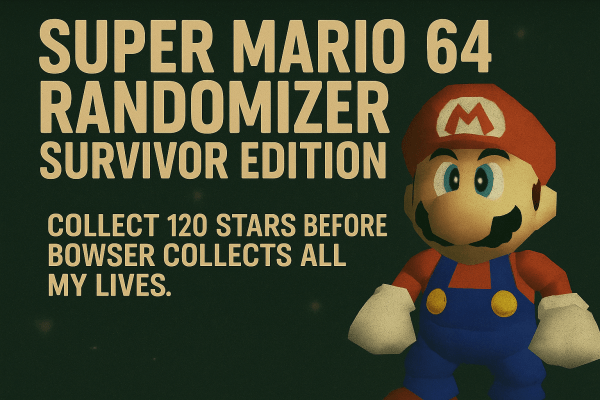
Super Mario 64 Randomizer – Epilogue: Thirty Years Later

Super Mario 64 Randomizer – Epilogue: Thirty Years Later

Game: Super Mario 64 Randomizer
Platform: Steam Deck
Format: No Commentary

Why This One Needed an Epilogue

It has been a while since I last wrote an epilogue, but this run felt like it deserved one.

Nearly thirty years ago we were given the game that set the standard for 3D platformers, and in many ways for games in general. Very few titles can be called truly influential, but Super Mario 64 is one of them. Even decades later people are still playing it, still finding new tricks, and still discovering ways to push the game further than anyone expected.

I have watched world records being broken, seen people complete the game blindfolded, and watched runs that make it look effortless. That was never what this was about for me. I wanted something familiar, but different enough that I couldn’t rely on memory alone.

That is why I chose the randomizer.

Familiar, But Never Safe

I could have played through the original game again without any problems, but the randomizer forces you to slow down and think. Stars are not where you expect them to be, levels don’t behave the way your memory says they should, and suddenly a course you know inside out becomes something you have to learn all over again.

It didn’t take long for the run to remind me of that. Getting Rainbow Ride and Tick Tock Clock early in the run felt like the game was testing me right from the start. Those are not the levels you expect to deal with when you are still trying to figure out where everything is.

And then there was the hunt for the Wing Cap Switch Palace. For a while I genuinely thought it might end up being in the very last place I could possibly check. That search alone made the randomizer worth doing.

The Stars That Fought Back

If there was one type of star that caused the most trouble, it was the red coins. A lot of them turned into puzzles I wasn’t expecting to solve.

Bowser in the Fire Sea was one of the worst. The coins were placed in spots where grabbing them felt like a risk every time. It wasn’t enough to know the level, I had to work out how to reach them without burning Mario in the process.

Rainbow Ride was another one that stuck with me. Collecting the red coins there only to see the star appear at the opposite end of the course felt like the game reminding me that nothing in a randomizer run is ever simple.

Even near the end the run kept finding ways to surprise me. Wet-Dry World being the final course felt a little anticlimactic, but that is the nature of a randomizer. You don’t choose the order. The seed does.

Thirty Years Later, Still Worth Playing

What surprised me the most about this run is how well the game still holds up. Even after all this time, Super Mario 64 is still fun to play, still satisfying to finish, and still able to throw challenges at you when you least expect them.

That is probably why people are still playing it after all these years. Not because of nostalgia alone, but because the game itself is strong enough to keep people coming back.

The Journey Ends

I don’t know if I will do another randomizer run in the future, but I’m glad I did this one. It turned a game I already knew into something unpredictable again, and it made the final credits feel earned in a way they normally wouldn’t.

This journey took longer than I expected, gave me more trouble than I planned for, and reminded me why this game became a classic in the first place.

For now, I’m happy to say the run is finished.

And I had a blast doing it.

Not Quite the End

As much as this feels like the end of the run, it doesn’t feel like the end of the experience.

Super Mario 64 might be finished, but I’m not done with it yet.

So instead of stopping here, I’m taking it further. The same ideas, the same structure, but rebuilt on a much larger scale.

Next, I’m stepping into a version of this game that doesn’t stay contained in a castle.

A galaxy-sized version of it.

Continue the Journey

← Log 25

🧢 Mario 64 Randomizer Hub

Some games never really get old. Sometimes you just need a different way to play them.

Returning to Tyria – A Moment I Didn’t Expect to Hit This Hard


I found out a few days ago that Guild Wars Reforged is coming out soon.
Updated UI. Steam Deck support pending. All campaigns bundled.
And the line that hooked me: existing players keep all their progress.

That was all it took.

I needed to know if my original account still existed.
If my characters were still there.
If anything I did almost twenty years ago survived.

So I turned the Steam Deck into a tiny PC again.
Installed Lutris.
Pulled down the old Guild Wars client.
Ran the full -image download.
Waited.
Then held my breath at the login screen.

And it worked.

Every character I made loaded instantly.
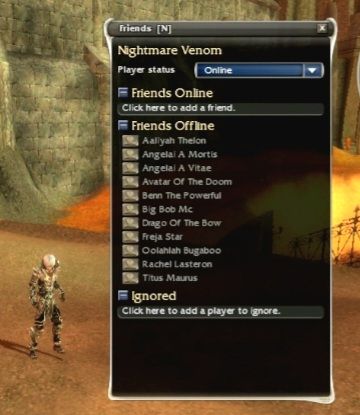
Nightmare Venom.
Spirits of Evil.
I Evil Arrow I.
All exactly where I left them.

Then I opened my friend list.

Every name hit me harder than I expected.
These were people I grouped with, explored with, wiped with, laughed with.
People I haven’t seen online in almost two decades.
Most of them probably don’t play anymore.
A few might not even remember Guild Wars at all.

But seeing that list again reminded me what this game meant to me.

So if anyone from that list ever finds this blog — even by pure accident — thank you for being part of my journey back then. You left more of a mark than you probably realise.

And if you do recognise me, please don’t mention my real name. Online names are more than enough here.
If you remember me and want to say hello, feel free to drop me an email at survivorincognito@gmail.com.

Guild Wars Reforged releases soon.
And for the first time in a long time, I feel like I’ve come home.

Blog at WordPress.com.

Up ↑