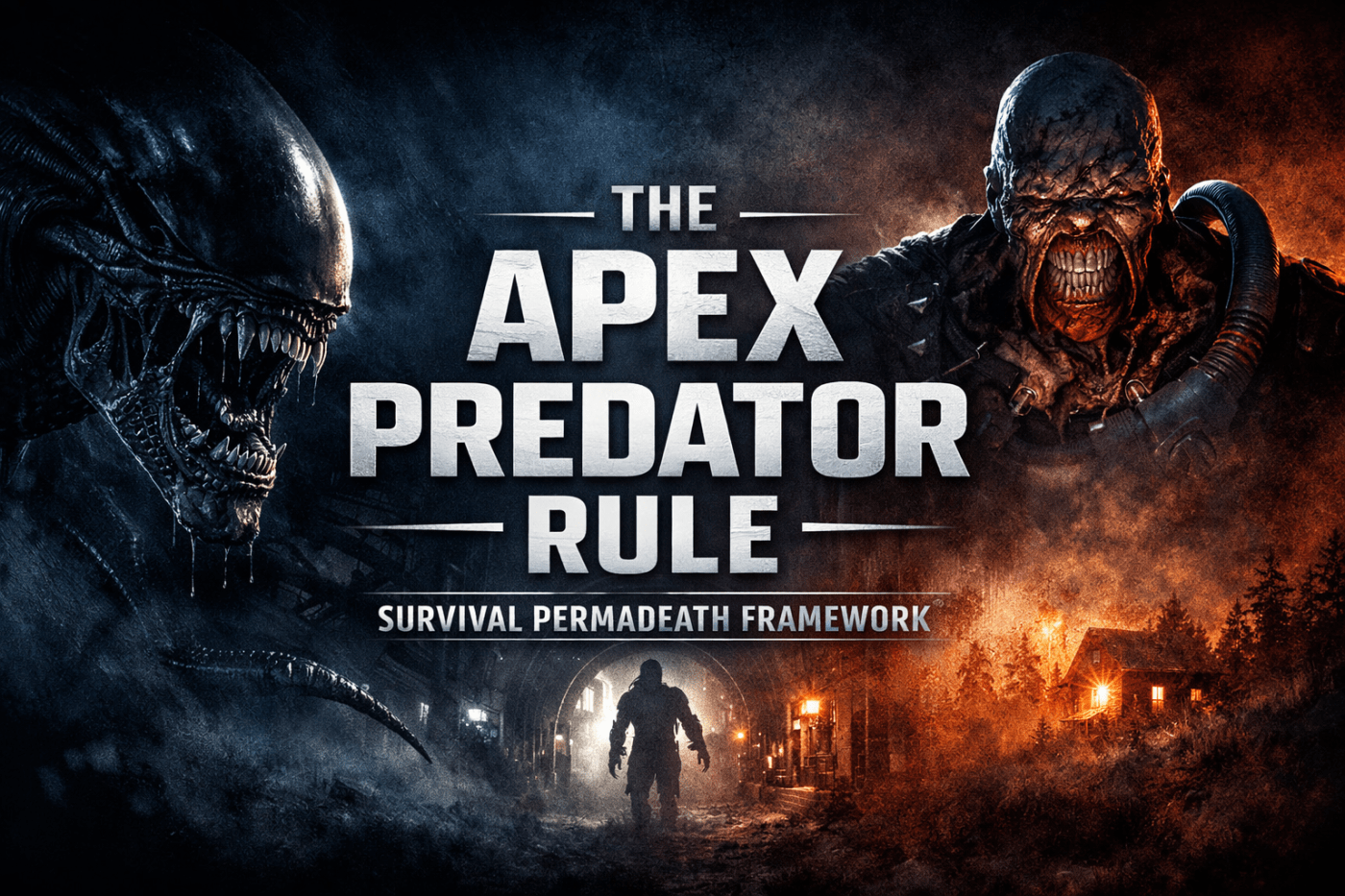
When a game revolves around a single, dominant threat, that threat defines the run.
The Apex Predator Rule keeps permadeath focused on the hunt instead of side systems.
What is the Apex Predator Rule?
Some games aren’t “survival against everything.”
They’re survival against one thing — the threat that shapes every decision you make.
In those games, the apex predator isn’t just another enemy.
It’s the pressure system. The pacing. The fear.
The Apex Predator Rule reflects that:
when the rule is active, only deaths caused directly by the game’s central predator
are treated as series-ending failures. Everything else stays dangerous, but it isn’t the point.
Why this rule exists
-
The threat stays central.
The series is about the apex predator, not random spikes or admin mistakes. -
Fear over frustration.
Predator deaths feel meaningful. Other deaths can feel arbitrary. -
Clear stakes for readers.
Everyone knows exactly what ends the run. -
Consistent series identity.
Each run stays focused on what makes that game what it is.
The Rule (TL;DR)
- Only the apex predator can end the run.
- A death caused directly by the apex predator counts.
- All other deaths are logged as failures, not endings.
Death Count Variations
The Apex Predator Rule defines what ends a run — but not always
how many chances are allowed.
The number of predator-caused deaths permitted can vary by game and series,
depending on how the threat is designed and how often the game expects it to kill you.
The key is consistency: the count is stated up front and never changes mid-run.
-
Single-strike:
One predator death ends the run immediately. -
Limited strikes (e.g. 3):
A small number of predator deaths are allowed across the series.
Used when learning the predator is part of the design. -
Zero tolerance:
Predator death ends the run instantly.
Used when the predator is avoidable by design and the game is generous about it.
Each series states its implementation clearly in the hub and in Log 1.
How deaths are counted
-
Apex predator deaths:
Any confirmed lethal kill by the predator (animation, grab, execution, etc.). -
Non-predator deaths:
Logged with cause and location, but do not end the series unless the specific series says otherwise. -
Scripted fail states:
Count only if the predator delivers the kill. -
Reload honesty:
If the predator killed you, it counts — even if you hard-quit.
Saving & honesty policy
- No dodging predator deaths. If the apex predator kills me, it is recorded.
- No mid-run rule edits. The strike count is locked in from the start.
- Failure logging. Non-predator deaths still get noted with cause and takeaway.
- No narrative editing. What happens, happened.
How it’s used in different games
The Apex Predator Rule is activated when one threat defines the experience.
That could be because the threat is iconic (it is the game),
or because the rest of the game’s danger can distract from the core hunt.
When a series uses this rule, the hub will state it like this:
- Apex Predator: (name)
- Rule Type: Single-strike / Limited-strike (X) / Zero tolerance
- Counts as a predator death: (what qualifies)
- Non-predator deaths: Logged / Ends run (series-specific)
Some games use the rule to preserve tension.
Others use it to stop the series being derailed by secondary systems.
Either way, the reasoning gets stated up front.
Examples
-
Xenomorph (Alien: Isolation):
Predator death counts when the alien kills you directly. Limited-strike may apply depending on the run. -
Nemesis (Resident Evil):
Predator death counts when Nemesis kills you directly. Strike count depends on the series format. -
Other apex threats:
If a single enemy defines the run, the rule may be activated for that series.

 Survivor Incognito