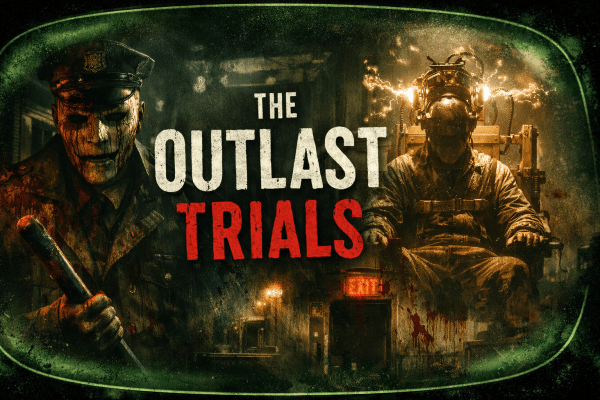
The Outlast Trials – A New Kind of Survival

I wasn’t planning on adding The Outlast Trials to the blog.
But sometimes a game doesn’t ask — it just gets under your skin and stays there.

After finishing the tutorial and stepping into my first real Trial, it became clear this was something different.
Not loud.
Not fast.
Just deeply uncomfortable in a way that lingers.

One Trial. No Safety Net.

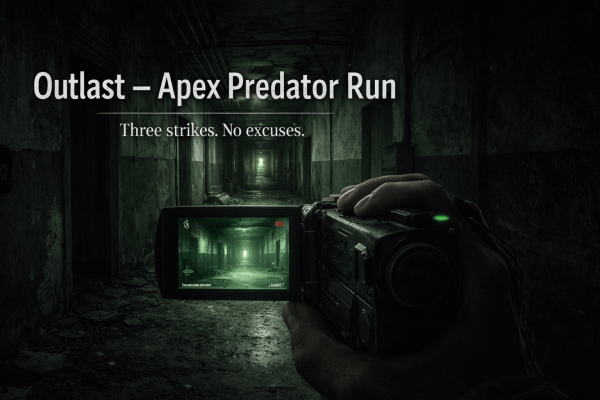
I recorded my first full Trial — Kill the Snitch, set in the police station.
Solo.
Lowest difficulty.
No cuts.

It still took 44 minutes.
And it was still unsettling.

Standing still felt dangerous.
Objectives felt like bait.
And the moment I assumed I was safe, the game corrected me.

Why This Fits Here

This blog has always been about surviving pressure rather than mastering systems.
The Outlast Trials fits that idea perfectly.

  • No PvP meta
  • No optimisation race
  • No pretending you’re in control

Just learning, adapting, and getting through it.

What This Is (And Isn’t)

This isn’t a full commitment to a new series.
There’s no schedule, no roadmap, and no promise of completion.

Think of it as occasional Trial logs — documenting progression, mistakes, and moments where the game genuinely gets inside your head.

If nothing else, it’s a reminder that survival horror can still feel tense without being exhausting.

Coming Up

The first Trial log will be going live shortly, featuring the full 44-minute run.
Viewer discretion advised.

Sometimes surviving means knowing when to slow down.
The Outlast Trials makes sure you do.

This entry is part of Survivor’s Dread, where survival horror is about tension and endurance rather than mastery.

My Top Grocery Store Staples

List your top 5 grocery store items.

When it comes to grocery shopping, I’m not chasing novelty. I tend to gravitate toward items that are reliable, flexible, and don’t require much thought after a long day. The goal is less inspiration and more sustainability.

Coffee is always at the top of the pile. It’s not about luxury or flavour notes — it’s about function. A decent cup makes mornings smoother and improves the odds of the rest of the day going to plan.

Bread is another constant. It’s simple, adaptable, and useful in more situations than it probably should be. Breakfast, lunch, or an improvised solution when plans fall apart — it usually earns its place.

Eggs are a quiet workhorse. Easy to prepare, hard to completely ruin, and useful whether there’s a plan or not. They’re the kind of item you’re glad you bought even when everything else in the fridge looks questionable.

Some form of basic protein usually follows, often chicken. It’s straightforward, flexible, and doesn’t demand much creativity to make it work. Practical food that does its job without fuss.

And finally, vegetables — usually chosen with realism rather than ambition. Whatever looks manageable that week. They add balance, keep meals from feeling too heavy, and make the whole operation feel slightly more put together.

Nothing exciting. Nothing showy. Just food that supports the day instead of complicating it. That’s usually enough.

A Positive Influence

Describe a man who has positively impacted your life.

I don’t really have one specific man I can point to as having clearly and directly shaped my life. There isn’t a single figure who stands out as a defining influence, and I’ve never felt the need to invent one just to fit the question.

What has mattered more has been a series of quieter influences over time. People who demonstrated consistency rather than charisma. People who handled responsibility without making a performance out of it. Those examples tend to leave a deeper mark than speeches or big moments.

I’ve learned more from observing how people deal with pressure, mistakes, and everyday obligations than from any grand lesson. How someone reacts when things don’t go to plan often says far more than how they act when everything is going well.

That process has shaped how I approach things myself. Staying calm. Doing the work. Not needing recognition to follow through. Those values weren’t handed down in one moment — they accumulated slowly, through experience and reflection.

So while there isn’t one person I can credit, the influence is still real. It’s built from observation, trial and error, and choosing which behaviours are worth carrying forward.

Sometimes the most meaningful impact doesn’t come from a single figure changing your direction. It comes from quietly deciding the kind of person you want to be, based on what you’ve seen along the way.

Dead by Daylight Isn’t Dead — But It Is Wearing Me Down

Dead by Daylight Isn’t Dead — But It Is Wearing Me Down

This is a harder post to write than I expected.
Not because I’m angry, but because Dead by Daylight is a game I used to genuinely love.
That’s what makes this year stand out — not one disaster, but how many small issues stacked up until enthusiasm quietly drained away.

On paper, Behaviour had a strong year.
In practice, it felt messy, defensive, and increasingly disconnected from the people actually playing the game.

Big Swings, Weak Follow-Through

There were real wins:

  • Major crossover moments
  • Long-requested licenses
  • Continued visibility and solid player numbers

But almost every win came with friction.
Momentum rarely turned into confidence.

The PTBs That Didn’t Listen

Twice this year, Behaviour tried to address slugging and tunnelling through PTBs.

The community response was immediate and consistent:

  • This won’t fix the problem
  • This adds frustration
  • This targets symptoms, not causes

Disagreement is normal.
Unified feedback being ignored is not.

When PTBs stop feeling like tests and start feeling like rehearsals for decisions already made, trust erodes fast.

The Livestream That Became a Case Study

The Walking Dead livestream should have been simple:

  • High-profile guest
  • One of the biggest DBD creators
  • A crossover meant to rebuild hype

Instead, it unravelled live.

Technical issues happen.
What mattered was watching the creator actively offer practical solutions — and being shut down by the developers on air.

That moment did more damage than the outage itself.
Flexibility gave way to control, and the optics flipped instantly.

Losing Michael Myers Changes Everything

This is no longer hypothetical.

Michael Myers — Dead by Daylight’s first licensed killer — is confirmed to be leaving the store.

Yes, if you own the chapter, you keep it.
The character will not disappear from existing accounts.

That does not soften the impact.

  • Myers isn’t just another license
  • He’s part of the game’s foundation
  • He proved licensed horror could work long-term in DBD

After Hellraiser, this confirms a pattern rather than an exception.
The unspoken promise that some things were permanent is gone.

“You Keep What You Bought” Isn’t Reassuring Anymore

Nothing is being taken away from existing players.
But the consequences are real:

  • New players lose access to a core horror icon
  • Foundational killers become legacy content
  • The game’s identity fragments over time

Live service games rely on trust that long-term investment matters.
That trust took a direct hit this year.

Licenses Won’t Fix Systems

Jason Voorhees would help.

  • Huge recognition
  • Immediate hype
  • A short-term surge in attention

But licenses don’t solve:

  • Tunnelling incentives
  • Slugging as pressure
  • Solo queue frustration
  • Meta fatigue

Without structural change, a new killer is a sugar rush — not a recovery.

This Isn’t Death. It’s Erosion.

Dead by Daylight isn’t dying.

What’s happening is quieter:

  • Players log in less
  • Defend the game less
  • Recommend it less
  • Shrug when things go wrong

That’s more dangerous than a loud collapse.

Why I’m Stepping Back — And Why That Makes Me Sad

This isn’t a goodbye post.

It’s a pause — and one I didn’t expect to need.

I wasn’t expecting to write a Dead by Daylight post for this blog at all.
At one point, I’d even planned a full page dedicated solely to DBD maps — layouts, loops, dead zones, the works.

That idea felt exciting then.
Now, it feels like a ship that sailed while I was still deciding whether to board.

Not because the maps stopped being interesting, but because my confidence in the game staying stable long-term quietly faded.
Without that confidence, it’s hard to justify investing that kind of time and care.

Maybe that changes one day.
I’d like it to.
But right now, this post exists not because I planned it — but because I needed to be honest about where things stand.

If Behaviour wants to steady the ship:

  • Announce less
  • Ship more
  • Fix incentives, not behaviour
  • Close the loop on feedback

Do that, and goodwill returns.

Without it, the game won’t collapse.
It’ll coast — carried by licenses and habit — while the people who cared most slowly disengage.

And that’s the part that genuinely makes me sad to write.

Clarification Note

  • Licensed content removed from sale is not removed from existing accounts
  • This post focuses on access, stability, and trust
  • Michael Myers’ removal is confirmed; broader concerns are based on precedent

Is My Life Today What I Pictured a Year Ago?

Is your life today what you pictured a year ago?

No — not really. A year ago, this isn’t where I expected things to be heading.

I definitely didn’t picture myself running a blog, let alone sticking with it and building something around it. It wasn’t part of the plan, mostly because there wasn’t much of a plan to begin with.

But here I am. Writing regularly, shaping ideas, and turning small moments into something tangible. It wasn’t predicted, but it’s been a good shift — one that grew naturally rather than being forced.

So while life today doesn’t match the picture I had a year ago, it’s not worse. Just different. Sometimes the unexpected route turns out to be the one that actually fits.

Not everything needs to be forecasted to be worth doing.

Breaking (and Rebuilding) the Team: From Meta Comfort to Controlled Chaos

Breaking (and Rebuilding) the Team: From Meta Comfort to Controlled Chaos

After earning Guardian of Cantha and finally clearing the Fissure of Woe, I reached that familiar point in Guild Wars where the question isn’t “Can this team work?” but “Do I actually understand why it works?”

That question kicked off a long stretch of trial, error, backtracking, and a few ideas that didn’t survive first contact with Hard Mode. What followed wasn’t a clean break from the meta — it was a slow, deliberate push away from relying on it blindly.

Where This Started

This journey sits on the shoulders of two earlier milestones:

Both were achieved using a fairly standard Mesmer-heavy approach. Effective, yes — but also safe. Too safe.

The Long Experiment Phase

What followed was a revolving door of ideas:

  • An Elementalist replacing a Discord Necromancer
  • A third Ritualist focused on Preservation instead of BiP
  • Dropping BiP entirely in favour of a Dervish frontline
  • Swapping that Dervish for a Warrior
  • Trying an Elementalist again
  • Reducing Mesmers… then adding them back

Some of these worked briefly. Others collapsed almost immediately. A few taught me why the meta exists in the first place.

The biggest lesson? I wasn’t actually trying to avoid Mesmers — I was trying to avoid depending on them.

Lesson Learned:
The goal wasn’t to remove strong tools — it was to understand when and why they were necessary.

The Turning Point: Silkfang

Somewhere in the middle of all this, a Ranger pet tank build entered the picture.

That experiment led to an unexpected constant: a spider.

A trip to the Underworld later, Margrid emerged with a Dire Black Widow. Over time, that spider stopped being a gimmick and became something else entirely — a reliable frontline presence, a pressure sponge, and eventually the team mascot.

That story lives here:

The Final Team (At the Time of Writing)

After all the iteration, the team settled into a shape that felt both familiar and earned:

  • Me – Signet of Spirits Ritualist (offensive spirit artillery)
  • Jora – Hundred Blades Warrior (frontline anchor)
  • Gwen – Panic Mesmer (AoE shutdown)
  • Norgu – Energy Surge Mesmer (spike and execution)
  • Razah – Ineptitude Mesmer (melee control and blind)
  • Livia – N/Rt BiP Healer (energy engine and sustain)
  • Xandra – ST Ritualist (Shelter, Union, Displacement)

Optional flex: Margrid and Silkfang can rotate in when a pet tank or ranged pressure makes more sense for the area.

Design Philosophy:
Proactive defense, layered control, and damage that doesn’t rely on perfect execution.

Early Results

At the time of writing, this team has already cleared two bosses in Slavers’ Exile on Normal Mode.

That’s not a victory lap. Slavers is long, punishing, and Hard Mode is the real test — but it’s enough to confirm that the structure holds up under sustained pressure.

Normal Mode confirms stability. Hard Mode reveals cracks.

Looking Ahead

Urgoz’s Warren and The Deep are firmly on the radar. Both test endurance and discipline more than raw damage.

The Domain of Anguish remains the line in the sand — not avoided, just not rushed. When this team goes there, it needs to be intentional.

Conclusion

This team didn’t come together because I followed a guide. It came together because I kept asking what wasn’t working, changed one piece at a time, and paid attention to the results.

Some ideas stuck. Others didn’t. And a few led me right back to concepts I thought I’d outgrown — including the realisation that sometimes the meta works because it genuinely does.

What matters now is that I understand why this team works. Where it’s strong, where it’s fragile, and what kind of content it’s built for.

If it holds together in the places that matter most, there’ll be more to write about. And if it doesn’t, that might be even more interesting.

Cities I’d Like to Visit

What cities do you want to visit?

When it comes to cities I’d like to visit, I’m less interested in ticking boxes and more interested in places that feel lived in. Cities with history, atmosphere, and enough character to explore without rushing.

Edinburgh is high on the list. Old streets, layered history, and the kind of place where wandering aimlessly still feels like progress.

Prague appeals for similar reasons. Architecture, walkability, and a sense that every corner has something to say without shouting about it.

I’d also like to see Tokyo. Not for the spectacle alone, but for how it balances intensity with order. It’s a city that looks overwhelming at first, then quietly efficient once you understand how it works.

On the calmer end, Amsterdam stands out. Compact, navigable, and built at a human pace. A city where movement feels natural instead of exhausting.

None of these are about luxury or big moments. Just places that reward curiosity, patience, and a bit of wandering — which tends to suit me better than rigid plans.

One Thing I Hope People Say About Me

Tell us one thing you hope people say about you.

If there’s one thing I’d hope people say about me, it’s that I’m reliable. Not in a flashy way — just someone who shows up, follows through, and does what they say they’ll do.

I don’t aim to be the loudest voice in the room or the centre of attention. I’d rather be the person who stays steady when things get complicated and doesn’t add unnecessary noise to the situation.

Being dependable matters more to me than being impressive. If someone can say I made things a little easier, clearer, or calmer just by being there, that’s enough.

Nothing dramatic. Just solid, consistent, and trustworthy. That’s the goal.

Super Mario 64 Randomizer – Log 6: Time Stops for No Mario

Progress: 38 Stars Collected | 82 Remaining | 21 Lives
Platform: Steam Deck
Settings: Vanilla Mario & Music

“When I looked into the light expecting peace and found Tick Tock Clock instead, I realised this run has no mercy.”

With Whomp’s Fortress cleared, I headed back to the basement to see what chaos was waiting this time. First win of the day: MIPS went down without a fight. One clean grab. One clean star.

Next stop: the Secret Aquarium. Straightforward as always. Then I spotted a platform that needed the Wing Cap. I don’t have it. I took the loss and moved on.

The big basement door — the one that may or may not lead to Hazy Maze Cave — is still locked. No key. No access. Back upstairs it was.

YouTube – Log 6 Video

Tick Tock Clock: Early, Unwanted, but Done

I looked into the light expecting the Wing Cap trial. I got Tick Tock Clock instead.

Shockingly, it wasn’t a disaster. Star placements were forgiving. No awkward jumps on tiny gears. No close calls over the void. The only real struggle was:

  • Grinding out the 100 Coin Star
  • Backtracking to collect the Red Coin Star

Annoying, sure, but manageable. And now the whole level is finished and off the board.

Rainbow Ride: Another Early Win

Like Tick Tock Clock, Rainbow Ride popped up early in this seed. Getting both out of the way now is a massive relief. Two of the most awkward courses cleaned up long before they can cause havoc.

Log 6 Summary

Lives 21
Stars Collected 38
Stars Remaining 82
Nightmares Cleared Early Tick Tock Clock, Rainbow Ride

Two tough courses gone. One rabbit caught. One fake Wing Cap entrance. A solid session.

Continue the Journey

Previous Log | Next Log

Super Mario 64 Randomizer Hub

How a Spider Became the Team Mascot

How a Spider Became the Team Mascot

The honest tale of one achievement, several experiments, and an eight-legged promotion.

It all started with Guardian of Cantha

After finally earning Guardian of Cantha — fifteen years late, but who’s counting — I marched straight into Fissure of Woe and cleared it.

Great moment. Great screenshots. Full Mesmerway.

Once the glow wore off, I had the realisation every returning player hits eventually:

Yes, this build works everywhere.
No, it isn’t my build.

So the dismantling began.

Breaking away from the meta

Mesmerway is powerful. Reliable. Efficient. And completely soulless.

I wanted friction again — a team I had to think about, not just preload.

So I tore the core out:

  • Panic instead of Energy Surge
  • Ineptitude for variety. Then swapped back for Energy Surge
  • Healers reworked
  • Soul Twist Ritualist fine-tuned
  • Necros rebuilt

It was messy, expensive, and brilliant.

But the frontline was still empty.

I wanted something alive up there.

The pet tank discovery

While looking for ways to create a stable frontline without going full Warrior or Paragon, I stumbled on the pet tank concept.

It solved more problems than expected:

  • Reliable aggro
  • High armour scaling
  • Expertise reducing the cost of support skills
  • No tendency to wander off like a melee hero

I just needed the right animal.

And if I was going to commit to this chaos, I might as well go all in.

The Underworld trip for a spider

Some pets are noble. Some are adorable. Some don’t immediately try to kill you.

I chose none of those.

One trip to the Underworld, a careful charm attempt, and I walked out with a Dire Black Widow who radiated “I will absolutely bite a god if required.”

At this point she had no name — just the spider. A silent, glaring addition to the roster.

But she earned her place fast.

Testing, tweaking, breaking things for science

With the spider holding aggro, the test runs began:

  • Zaishen vanquishes: smooth
  • FoW: promising
  • UW: somehow alive longer than expected
  • Tombs: died to siege wurms, but everyone does
  • Multiple hero rewrites: several necromancers were harmed during development
  • Elementalist experiment: retired politely
  • Barrage tests: fun but not quite right
  • Dervish added to the frontline: finally clicked

Piece by piece, the team rebuilt itself into something new.

The frontline comes together

The final breakthrough was adding a Dervish.

Avatar of Melandru. Durable. Clean aggro. Good synergy with the healers and spirit line.

Suddenly the frontline wasn’t theoretical anymore:

Dervish + Spider.
Heavy hitter + tank.
Structure + chaos.

It worked.

But the real test was still ahead: Shiro Tagachi, Hard Mode, Master’s reward timer.

The Shiro fight — where the spider earned her name

I entered the Imperial Sanctum fight expecting to scrape by. I left it staring at the clock:

1 minute 55 seconds.

Shiro never recovered from Broad Head Arrow. The Dervish tore through him. The team melted health bars like they owed us money.

And the spider?

She tanked. She held aggro. She bit Shiro with the commitment of someone settling an old grudge.

When the dust settled, I looked at Margrid’s widow and muttered:

“…Silkfang. That’s your name.”

Because after that performance, she wasn’t “the spider” anymore. She was part of the team — the part that didn’t flinch.

And that’s how the mascot was born.

Silkfang, as I imagine her in real life: not monstrous, not magical — just a fiercely alert black widow with enough intelligence behind the eyes to understand every fight before it starts.

Why Silkfang stays

Not because she was planned. Not because she’s optimal.

But because she embodies the whole journey:

  • Breaking the meta
  • Experimenting with builds
  • Finding joy in nonsense that somehow works
  • Rebuilding the team into something uniquely mine

Silkfang is the symbol of all of that.

A quiet, eight-legged reminder that sometimes the best part of Guild Wars is abandoning the expected path and discovering something brilliant in its place.

Long live Silkfang. Frontliner. Mascot. And the only creature in Tyria who can tank Shiro without complaining.

Blog at WordPress.com.

Up ↑